

By Ioanna Theou
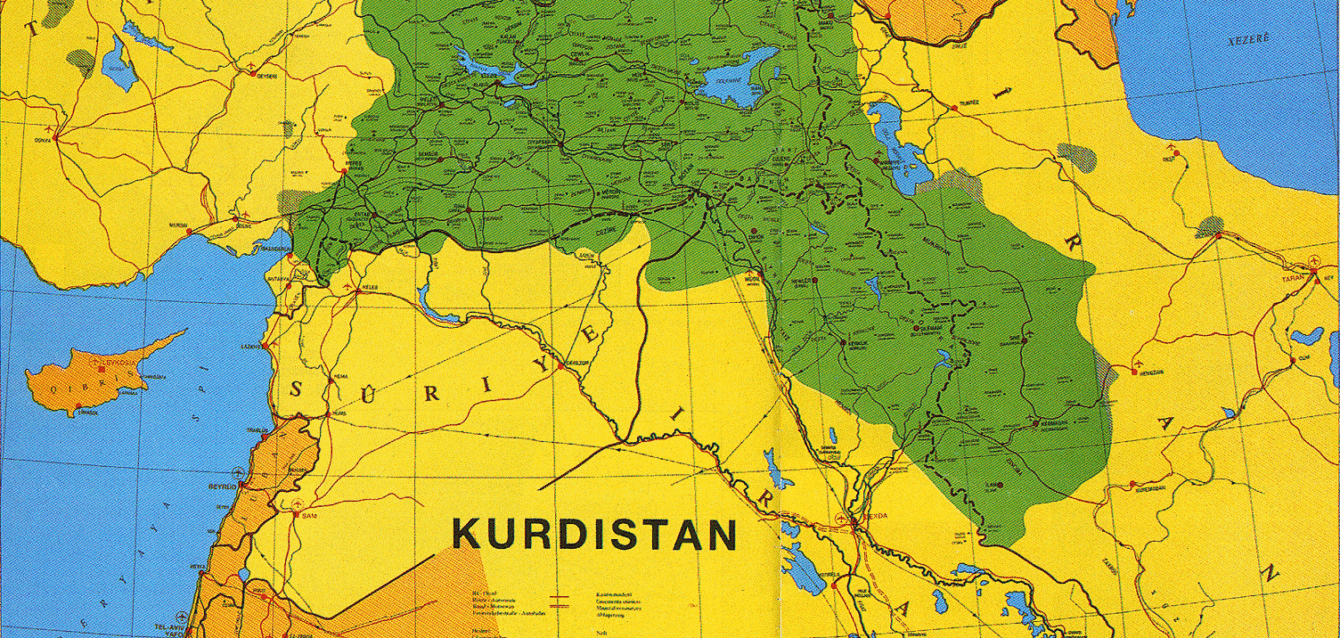
The Kurdish people is a distinct ethnic group native to the Middle East and have aspired to self-determination for a long time. After World I, the victorious powers of the Entente (Great Britain, France, US) initially promoted the idea of an independent Kurdistan in the 1920 Treaty of Sevres. This initial idea was a clear punishment for the former Ottoman Empire, because of its cooperation with Germany. However, this promise was never fulfilled. The Treaty of Lausanne in 1923, established the borders of modern Turkey and excluded any provision for a Kurdish state, leaving Kurds stateless and divided in four countries.
There are Kurds living across Turkey, Iraq, Syria and Iran. In Turkey, there is a large Kurdish population, who unfortunately, faced systematic suppression. From the foundation of the modern Turkish state through the 20th century, the Turkish state pursued an aggressive policy of assimilation toward the Kurds -and of course toward all the non-Muslim minorities, such as the orthodox Greeks and Armenians. Kurds were often referred to as ‘’Mountain Turks’’, or described with other non-flattering words. The Kurdish language, culture, music and even the Kurdish names were banned from public life. This approach sought to erase the Kurdish identity in favor of a homogenous Turkish identity, consistent with the phrase of ‘’one nation, one language’’.
When the Kurds resisted and defended themselves, they often faced brutal repression by the Turkish governments. The Dersim massacre of 1937-38 is one example of this kind of brutal repression. Tens of thousands Kurdish civilians, including women and children, were killed or even displaced by the Turkish army. Beyond this violent massacre, the Kurdish people had to constantly defend themselves from racism and discrimination practices. The Turkish media and textbooks stigmatized the Kurds. Therefore, the Kurdish groups were being persecuted or marginalized by the Turkish government and political conservative Turkish groups.
The tension between the Kurdish population and Turkish governments continued systemically and intensified with the killings of Kurdish businessmen, politicians, civilians. The Kurdish people reacted and established the Kurdistan Workers Party (PKK), led by Abdullah Ocalan. PKK launched an armed response against the Turkish state. Initially, the PKK calling for independence, but later shifted toward advocating for Kurdish political rights within Turkey, after Ocalan’s capture in 1999. The ensuing decades were marked by violence, village displacements, and widespread civilian suffering.
The rise of the Justice and Development Party (AKP) in 2002 brought hope for the Turkish-Kurdish relations. The AKP, led by Recep Tayyip Erdogan, initially pursued a reformist agenda, motivated by Turkey’s EU accession aspirations. Early initiatives included limited recognition of Kurdish cultural rights, permission for private Kurdish- language broadcasting, and acknowledgment of the need to address the ‘’Kurdish issue’’. In a speech in Diyarbakir (2005), President Erdogan publicly admitted Turkey’s historical failure to treat its Kurdish population fairly- in essence admitting the failure of previous Turkish governments regarding the Kurdish issue.
Despite these small steps, the reforms remained partial and uneven. Kurdish political integration into state institutions was limited, and promises regarding education, rights, and cultural expression were never implemented. The Kurdish population electorate gradually grew skeptical of the AKP’s commitment, while the PKK maintained a defensive posture, aware of ongoing repression and unfulfilled reforms. The political climate of 2007, shaped by domestic polarization and broader regional instability, further complicated the AKP’s approach, resulting in violence and renewed distrust.
The 2010’s offered another moment of potential transformation. Erdogan’s government initiated a historic peace process with Ocalan and the PKK. Ocalan publicly renounced secessionist goals, advocating for a democratic resolution, within Turkey’s borders. A ceasefire, followed and some reforms were introduced, including limited Kurdish- language broadcasting and cultural recognition. However, the peace process collapsed in 2015, driven by the Syrian civil war. Urban clashes erupted, Kurdish politicians were arrested, and the pro-Kurdish HDP party faced widespread repression. Hopes of reconciliation did not materialize, and decades of mistrust resurfaced.
From 2015 and the early 2020s, conflict persisted alongside continued repression of Kurdish political actors. Notable incidents of violence against Kurdish civilians, political leaders and activists emphasized the fragility of Turkish- Kurdish relations. Yet, by 2024-2025, subtle signs emerged of a potential thaw. Facing domestic economic challenges and regional volatility, Erdogan and his allies made statements about the need for ‘’peace at home’’. Devlet Bahceli, leader of the nationalist MHP and Erdogan’s coalition partner, even suggested the possibility of Ocalan being placed under house arrest if the PKK disarmed- a shift from prior strict positions. Ocalan showed willingness to contribute to a peaceful process.
In early 2025 Ocalan publicly called for the PKK to lay down arms and dissolve itself, a historic declaration that marked a turning point in the Turkish-Kurdish relations. The PKK’s leader announced a unilateral ceasefire. A resolution of the Kurdish issue offers Turkey moral and strategic gains. Domestically, ending decades of conflict would lift a massive security burden, reduce social tension, and allow economic development in Kurdish- majority regions. Regionally, Turkey’s relations with the Kurdish groups of Iraq, Iran and Syria are difficult to improve -due to Turkishs fear about the creation of the historic state of Kurdistan, the military operations in northern Syria and of course, the impact of the Davutoglu Doctrine and the Turkish National Oath (Missak-i Milli). Erdogan wants to make sure that the Kurds of Syria, Turkey, Iran and Iraq won’t be unified. Internationally, resolving the Kurdish question would improve the status of Turkey.
The Kurdish Issue under the AKP reveals a persistent gap between rhetoric and reality. While Erdogan initially “tried” to find a solution to the Kurdish issue with various promises, and reforms -particularly in the early 2000s- these gestures never fully materialized…
Instead, the Kurdish Issue has been instrumentalized, serving short-term electoral and strategic goals rather than a long- term vision of inclusive governance. Erdogan’s vision is simple. He wants a centralized Turkish state with a strong regional role. Therefore, Erdogan’s desires shaped by neo-Ottoman and Islamist narratives – he is an active member of Muslim Brotherhood for example – prioritized territorial integrity, centralized authority, and regional influence. Within this framework, the Kurdish movement -especially in its transnational dimension- represents not a partner for a peace, but a structural challenge to Turkey’s regional ambitions. This strategic logic is evident in Turkey’s military operations and goals in northern Syria.
Bibliography
Α. Derisiotis, ‘’Erdogan, Turkey’s Kurds and the regionalization of the Kurdish issue’’, New Middle Eastern Studies, vol. 1, 2019, pages 52-63.
Washington Kurdish Institute, ‘’Turkey’s Peace Process with the Kurds: History, Challenges, and the Path Forward’’. https://dckurd.org/2025/09/26/turkeys-peace-with-kurds/
M.Nashed, ‘’Kurdish Leader Ocalan told the PKK to disband, it: Here’s what to know’’, Al Jazeera, 13/05/ 2025.
X. D. Minagias, Turkey: Revisionism and Conflicts, Leimon, Athens, 2019, pp. 225-226.
‘’Erdogan’s Advisor- If you Push Us, we will Take Thessaloniki Too’’, Vima, 21/12/2021.
L. Kenez, ‘’Erdogan continues to support Brotherhood ties to shape his image among Muslims’’, Nordic Monitor, 09/09/2025.
A. Mardin, ‘’ Too obvious to conceal: Ankara’s threats herald a northern Syria operation – opinion’’, the Jerusalem Post, 17/12/2025.
https://www.jpost.com/opinion/article-880526
W. Hale, ‘’Turkey and the Syrian Civil War’’. Insight Turkey Fall 2019, Vol. 21, No.4.
https://www.insightturkey.com/commentaries/turkey-the-us-russia-and-the-syrian-civil-war