

By Katerina Armenopoulou
Each of us uses symbols, consciously or unconsciously, in how we move, speak, or imagine creation. Works of art, patterns, many of our habits, even gestures and many images we see around us, send a message. This message can affect us and even change our psychological state depending on its content and the way it is understood. Symbolically, however, as a result of its late development as a practical science, it is still not able to fully define the meaning of a symbol for it and remains a symbol open to subjective interpretations.
The ancient world was full of symbols. The perception of symbols, as essential elements of human spiritual life, reached a real level only in the past century. The sciences that helped interpret symbols and, through them, understand ancient cultures were ethnology, the history of religion, and psychoanalysis. They actually introduced the terms ‘symbol’ and ‘image’.
In psychoanalysis, the symbol has the ability to penetrate deeply into the soul. It separates and at the same time connects the conscious with the subconscious.
In art, the symbol is distinguished and at the same time linked to the object being portrayed or represented. Symbols that no longer provoke the same spiritual response in humans, as was the case with ancient civilizations, mean something more than just a few signs we pass by hastily on our way.
Before starting to describe and analyze the symbolism of the snake, it is necessary to briefly refer to the usefulness of symbols. I also emphasize the need to separate symbols from images, which often leads us to believe in all ancient pagan people.
Simply put, we can say that a symbol is the tool that sends a message. It is an object or representation used to stand for a concept, an idea, or information similar to the displayed object. An identification system, a sign, or representation helps to decipher the meaning it conveys. In this way, the symbolic representation of concepts and objects forms the basis of communication between two or more disciplines or groups.
The alphabet and numbers are the first signs that a person is learning.
A symbol is a kind of code. It is the external expression of a truth that is symbolized and is a means of conveying information through a method other than language, thus avoiding unclear areas and excessive complications.
Symbols can be ‘global’ because there are multiple ways to complete them, always depending on the edge of their compositions. A symbol can have an internal or external problem, and thus, the easier and most common interpretation may not be complete. It may only be ‘half true’.
To analyze a symbol conceptually, we need to understand its roots, the causes of its emergence. A symbol can have universal validity, and a universal symbol is recognized internationally, for example, the arrangement of the five Olympic rings of the brand. This can be an effect, but partially, as the form of a cross for Christians or it has a purely local significance, like a sign of a sports team in a place.
There are various sources from which its symbol of power and identity is derived. The divine takes the first step. Man follows. In religion, the symbol is identified with the concept of the Divine. In ancient times, people often attributed to the divine what they could not explain. Through their creations, using signs and symbolic images.
Greek mythology is an opportunity for a major route through which it paints a clearer image with a symbolic character. No other animal, the snake, has been more symbolic due to its shape, its place, and its flexibility, because of its existence in nature, appearing both on land and in water. In this way, the snake is one of the most important, yet complex, symbols, not only in Greek mythology but in the world.
The worship of snakes in antiquity is deeply connected to people or objects related to religion, mythology, or medicine. The search for a way to worship snakes through symbols finds its origin in prehistory, moves from the Evil Snake (god-demon) of the ‘underworld’ and from the snake of the Bible, to finally reach the symbol of Asclepius. It is a symbol that was widely used and became very widespread.
In reality, there is no reptile that is so widely represented and known in the world. It is the emblem of all medical offices, the symbol of the messenger Hermes, has been and still is a religious emblem, and has become a frequent theme in visual art. Mythology and popular tradition refer to goddesses, heroes, or monsters who had a relationship with the snake. Interesting is the correlation of snakes with prehistoric medicine, where they appear as goddesses in mysteries-ceremonies of restoration, spiritual or therapeutic. Even more interesting is their use as emblems with an artistic aspect.
Trying to find the ancient origin of the myth in past centuries, we also turned our attention to the transformation of the Greek gods and especially the traditional Serpent, so-called of the ‘Underworld.’ This serpent is claimed by many other mythological entities. In antiquity, serpents were intertwined with death and had a sense of embodiment with the gods of Hades, with heroes of death, or even with ordinary people.
These symbols are closely related to Greek mythology. In this close relationship, the ‘protagonists’ are Asclepius (the god of medicine) and Hermes as we already mentioned. It is true that snakes can be found everywhere, even in the Bible and the Old Testament, but also in traditions based on a metaphysical theory about snakes. An illustrative example is the Cyclades islands in Greece, which are full of snakes. The uniqueness of the locality of Delos is due to the fact that, in houses and small churches, snakes were traditionally worshiped. A tradition that came from Egypt through Crete. In Knossos, they incorporated them into part of the ceremony, while in Delos they honored them as ‘divine household goddesses’ and, of course, they played the role of protecting the homes.
It is also a resurrection through the skin, which can be renewed with the changing of the seasons. Nowadays, however, it is the object of terror, corruption, and for the Christian world the same temptation, the Devil, the enemy of God, the factor of downfall, while for the ancient world it was an object of worship and more.
People have a mistaken impression of the snake symbolism, as a symbol, it has not managed to keep its original meaning intact in all seasons, but it may be worn out or have evolved into something completely different. Symbols are subject to the right of variation, but it has never been the case that they disappear. They can adapt to each season.
In Homer’s Iliad, a vulture appears holding a wounded snake in its claws. A prophecy (Calchas) interpreted it as a sign of the Greeks victory. The theories that the Phoenicians brought serpent worship to Greece from Egypt, are not true. Nowhere in the world is there a myth as developed about serpent-gods as in the land of the ancient Greek spirit, namely Crete. Ancient art has left us serious evidence in support of this claim.
From a multitude of artworks belonging to Minoan culture (4000 – 2000 BC), we will refer to two of the most well-known sculptures of the mystical snake goddess from the palace of Knossos: the sculpture of the goddess of fertility holding a snake (1600–1580 BC).

The ‘Snake Goddesses’ were excavated at the palace temple of Knossos. They are examples of objects for worship and rituals, not everyday items. It is very likely that they represent the Snake Goddess with her daughter. The larger terracotta of the two is the one with outstretched hands, with snakes crawling over her body, on her shoulders, and even on her tiara. The other piece is smaller, holds the snakes in raised hands, and has a small animal on her head.
She is dressed in a special ceremonial garment, that is, a long skirt and a short corset, which covers the upper part of the body except for the chest. The statuette is currently housed at the Archaeological Museum of Heraklion, in Crete. Through their naturalism and plasticity, these are some of the most important examples of Minoan art.
Another statuette-idol of a woman, one of those commonly called ‘goddess of fertility’ is the one below and is exhibited at the Archaeological Museum of Heraklion.

She has a wide pelvis, a necessary qualification at that time for easy childbirth, and with her hands she shows off her pregnant belly. Similar vows are still made today, in Christian churches. What is striking, however, is not that the woman is pregnant, or that she is dressed, or that she is wearing a special hat. But the fact that her scaly legs, as well as their wrapping, resemble a coiled snake. The woman’s human body seems to spring out of a coiled snake. We also can see an early form of the snake-goddess or the ‘Goddess with the Snakes’ of Knossos, because there is no virgin birth. The figurine was found in Ierapetra, Lasithi, Crete and is made of clay. It was made in the Middle Neolithic period (i.e. approximately 5800-4800 BC).
The characteristics of the snake gave the ancient man the right to attribute to it a ‘daimonic’ character and monstrous dimensions, which later created figures like Typhoreas, Centaur, Chimera, etc. It is important that such figures existed on the bone seals of the Minoan era. The snake remains fertile, comes out of the earth and enters it, thus encountering the dead, living in their tombs, and it is logical that it becomes, in a sense, the reincarnation of the dead.
Many times in ancient Greece, but also today, the serpent is likened to the spiral. Its major symbolism is connected to a cult of Zeus Meilichios, associated with the acquisition of Erkeiou Zeus and Jupiter. As Father Zeus, he was worshiped throughout ancient Greece as the patron of the household.
The encounter with the snake in the form of various monuments and, in particular, altars in the house of worship.
It is important to mention that other deities were associated with the house snake. The Dioscuri, whose key symbols are the ‘trap with pedal’ and amphorae, were depicted together with representations of snakes. Agathodaemon, another god in the form of a house snake, was discovered in Santorini. In one of the household altars of Thera, his name was carved. After lunch, the inhabitants of Thera used to pour a few drops of wine on the floor as an offering to him.
For the cosmology of the primitive snake, it is the matrix of life itself, the hermaphroditic god. With circular movements wrapped around the cosmic axis, it thus becomes the main pillar of the world. In the Far East, and barely distinguishable from dragons. As herpetai, rallies, and spreading, it disappears and reappears, symbolizing the spirit that intervenes in everything, penetrates, and is the inner nature of man consciousness. This is a fair description of the most important phallic symbols; they are often accompanied by female deities (see the serpent goddess who holds snakes in the hands of Minoan Crete, the place where serpent symbolism dominates).
There is evidence of a protheistic snake cult represented in statues and other objects from the ancient world, coiled around them. Therefore, it is a symbol of productive land and, consequently, a symbol of fertility. By shedding its skin, it is associated with the phases of the moon. The Moon, Mother Earth, and the serpent are the three components of the lunar worship system. This composition reflects fertility and immortality.
The snake is a symbol of chthonic Zeus, because the soul of the ancient Greeks leaves the body of a dead person symbolized as a snake, and it demonstrates the aggressive forces of the gods from the underworld, thus darkness.
The snake, living underground, has magical powers that derive from the dead, which also equate to deceit, malice, and wickedness. Female deities of ancient Greece like the Furies, Medusa, and Grea are always associated with the snake, symbolizing forces of magic and sorcery, the wisdom and deceit of the snake.
As mentioned above, the complexity of meaning makes the symbolism of the snake ambiguous, as it was a symbol of renewed life and healing, because it was characteristic of Asclepius, Hippocrates, Mercury, and health.
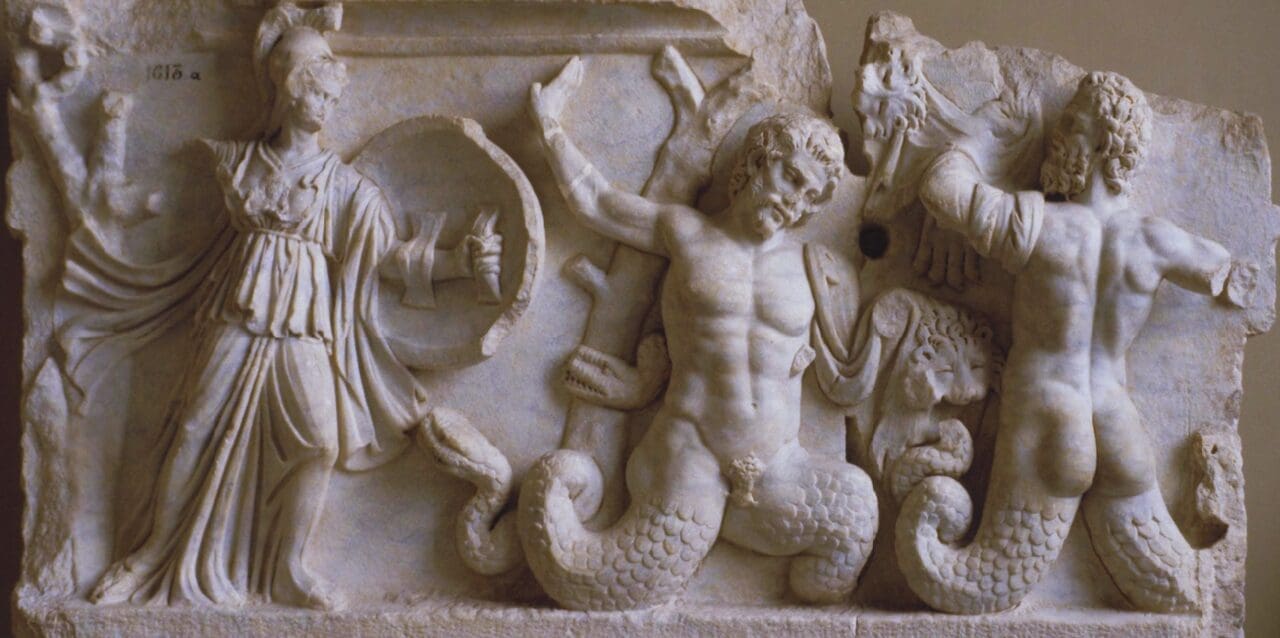
For the ancient world, it is therefore a symbol of medicine, knowledge, and divination. Dedicated to the goddess Athena (see the depiction on the shield), it was a sign of wisdom.
The same symbolism was also seen in the god Apollo of Delphi (who massacred the Python and floods of darkness), the goddess Rhea (the Great Mother who holds snakes), for the Bacchae, a fireplace, and all female fertility deities of the ancient Mediterranean cult (Arcadian Artemis, Hecate, and Persephone).
Snake as an element is widely found in many traditions of coupling a female deity with it, which leads to ‘special’ children. The symbolism of the snake varies, even extending beyond today’s serpent worship according to the lore, wishing to guard the house as a continuation of Meilichios Jupiter. In many places in Greece, tradition even forbids killing them.
In conclusion, as a tribute to this symbol, and to symbols in general, the modern man who has inherited the symbols, sets them in different objects, window frames, hangs them on the walls and doors of houses, as jewelry or hand, such as the Christian cross. As a favor, therefore, they are made from any material, but especially from precious metals and stones. The symbols are clearly approached according to human mental faculties. Help him think, to reflect and remember a meaning, to communicate, grow intellectually, to cultivate his inner world and express his ideas. They are still unknown and mysterious. They are the world that reveals the spirit and soul of the people of the past. We can say that the symbol, beyond what we perceive and experience, is a mirror of our culture and our civilization.
A civilization that brought enlightenment to the entire European continent, as well as to modern Western civilization, shaping the foundation for the arts, democracy, and the development of thought. Laying the cornerstone for the democratic states that were created, and implementing a very powerful tool for spreading culture. Many manipulation tools, after all, were used by specific centers in the past, which, with soft power, imposed ideologies and ways of behavior. Therefore, art, its symbols, its meanings, and everything it represents, is not so simple or innocent. It has power. It has meaning. It can influence for the benefit of Greece and become a significant geopolitical weapon.
Bibliography
- Chevalier Jean & Alain Gheerbrant, Dictionnaire des Symboles, edit. Robert Laffont, Paris 1969
- Cooper J. C., An illustrated Encyclopaedia of Traditional Symbols, Thames and Hudson Ltd, London 1978
- Eliade Mircea, Images et symbols, ed. Gallimard, Paris, 1980, Tratat de istirie a religiilor, Editura Humanitas, Bucuresti 1992
- Yung Karl Gustav, Omul si simbolurile sale, Editura Arsenidis, Atena 1968
- Humbert Raymond, Le symbolisme dans lʼart populaire, Paris 1988
- Ikonomidis Dimitrios, Naxos si Traditia, «Folklor», Vol. ΙΖ΄ / Atena 1957-1958
- Schure Edouard, Profeţii ale Renaşterii, Atena 1956