

By Ioanna Theou
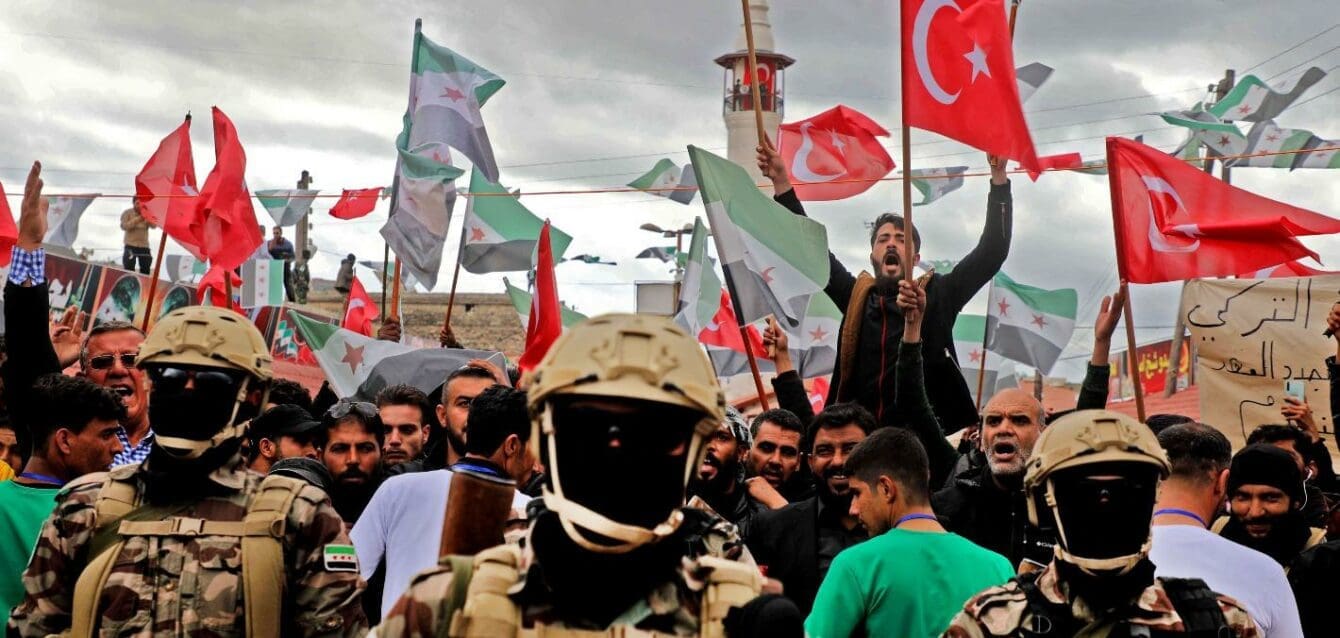
Turkey’s position in the Syrian civil war has been shaped by security concerns -due to the Kurdish presence close to the Turkish borders-, geopolitical ambitions, regional rivalries and ideological motivations. The beginning of the Syrian civil war in 2011, was a pivotal moment for Ankara because Erdogan and his party had the opportunity to redefine the strategic role of Turkey in the Middle East, attempting to create and influence the political future of Syria, contain Kurdish aspirations for autonomy, and increase military and diplomatic power in its neighboring countries. The military operations it launched in northern Syria -Euphrates Shield (2016), Olive Branch (2018), and Peace Spring (2019)- represent important elements of Turkey’s evolving doctrine of regional intervention.
This article explores Turkey’s overall stance toward Syria, its political goals and the significance of its military campaigns in reshaping the balance of power on the ground. At the beginning of the Syrian tensions, Turkey adopted a cautious diplomatic approach, attempting to be a ‘’mediator’’ between Bashar al Assad and the opposition groups. Prior to 2011, relations between Erdogan and Assad had improved significantly, characterized by trade agreements, security cooperation and open border polices. However, as the conflict continued, the Justice and Development Party (AKP) government shifted its policy. Initially the Turkish president tried to be a mediator -between the regime and the opposition groups- but soon enough this policy was unsuccessful, and the Turkish policy shifted to a new direction. Turkey openly supported opposition groups and called for regime change.
This transformation was guided by three main considerations. Turkey perceived the Arab Spring events as an opportunity to extend its influence across the Middle East, under a model inspired by political Islam. The AKP leadership, and especially the former Foreign Minister Ahmet Davutoglu, believed that Ankara could shape a new regional order by supporting Sunni Islamist political movements, including the Syria Muslim Brotherhood. Let’s not forget, President Erdogan is an active member of the Muslim Brotherhood. The most critical factor driving Turkey’s intervention has been the rise of Kurdish militia groups close to its southern border. The increasing power of the Kurdish militia groups is a threat for Ankara because it views the Turkish Kurdish party of PKK as a direct threat to Turkish territories and national security.
Finally, Ankara’s relations with Washington and Moscow changed dramatically the nature of the conflict. While Turkey is a NATO member, it frequently clashed with US policy, especially due to American support for the Kurdish-led Syrian Democratic Forces (SDF). Turkey’s cooperation with Russia intensified after 2016, despite the disagreements over Assad’s future. On the one hand Russia needed Turkey in order to have access to its Russian military bases in Latakia and Tartus and on the other hand, Turkey with its foreign policy distanced itself from US and NATO. The Turkish-Russian relations allowed Turkey to pursue its strategic interests in northern Syria.
Turkey’s official position emphasizes two core objectives. Firstly, for Ankara, the emergence of a Kurdish-controlled corridor stretching from Iraq to the Mediterranean, would radically alter regional geopolitics and potentially encourage separatist sentiments within Turkey’s own Kurdish population. Thus, blocking Kurdish territorial consolidation has become the central pillar of Turkish policy. Even though Turkey’s demands for full regime change became less realistic over time, Ankara continued to pressure for a political solution that limited Assad’s power and allowed Sunni Arab opposition forces -many of which it still supports- to retain influence. Turkey wanted to maintain a sphere of influence in northern Syria to shape government structures, refugee returns, and local security dynamics.
Turkey launched three major military operations, each with distinct strategic purposes but, off course, all centered on countering Kurdish territorial control. The first Turkish military operation was with the code name ‘’Operation Euphrates Shield’’ between 2016-2017. This military operation was Turkey’s first large scale intervention in northern Syria and the main goal of the Turkish state was to create a ‘’safe zone’’ between the Turkish- Syrian borders, and to prevent the unification of Kurdish-held territories. The second military operation had the code name ‘’Operation Olive Branch’’ and this second offensive military operation targeted the Kurdish population of Afrin, a region under YPG control. Many innocent Kurdish people were killed in the process…
The last Turkish military operation was launched with the code name ‘’Operation Peace Spring’’, in 2019 and after the US partially withdrew troops from northern Syria. Peace Spring aimed to seize territory between the cities of Tel Abyad and Ras al- Ayan. These three military operations confirmed Turkey’s long term-vision of maintaining military presence in order to influence the new Syrian regime. These Turkish interventions had profound implications on the domestic, regional, and international level. More specifically, Turkey’s military presence reshaped the dynamics between Russia, Iran, the Assad regime and the United States.
Ankara succeeded in preventing the full collapse of Syrian opposition forces and created leverage for political negotiations. The Turkish military operations weakened Kurdish military capabilities and reduced the geographical continuity of Kurdish-controlled regions, but also pushed Kurdish groups to continue their cooperation with major powers such as the US and even the Syrian regime at the time. The military operations in northern Syria have bolstered nationalist sentiment within Turkey, strengthening the AKP’s political narrative and its alliance with the Nationalist Movement Party (MHP).
Turkey’s goal in Syria initially was to remove the Assad regime, but this position proved unattainable. Therefore, Ankara has successfully entrenched itself in northern Syria, shaping both the military and political landscape of the conflict. The military operations -Euphrates Shield, Olive Branch, and Peace Spring- were not merely tactical maneuvers but part of a long-term strategy to prevent Kurdish autonomy, assert Turkey’s regional influence, and secure a role in the reconstruction of post-war Syria. Turkey remains a central actor whose decisions will significantly influence the balance of power in the northern Syria.
Bibliography
I. Mazis, Geopolitics of Middle East and Turkey, Livanis, Athens, pp. 59-60.
M. Sarlis, Syria, Turkey, and the geopolitics of Middle East, Leimon, Athens, 2021, pp. 72-73, 85, 94-100, 115-116, 120-126, 130-136
St. Larrabee, ‘’Turkey Rediscovers the Middle East’’, Foreign Affairs, Vol. 84, No. 4, July- August 2007, pages 105-106.
P. Zalewski, ‘’How Turkey Went from ‘ Zero Problems’ to Zero Friends’’ ,Foreign Policy, August 22 2013, https://foreignpolicy.com/2013/08/22/how-turkey-went-from-zero-problems-to-zero-friends/#:~:text=It%20expanded%20business%20and%20trade%20links%20with%20Arab,Israel%2C%20Fatah%20and%20Hamas%2C%20and%20Pakistan%20and%20Afghanistan
Reuters Staff, ‘’Turkey’s Erdogan Says New Chapter Emerging in Relations with Russia’’, Reuters, August 9 2016, https://www.reuters.com/article/us-russia-turkey-erdogan-idUSKCN10K15O
K. Shaheen, ‘‘ Turkey Starts Ground Incursion into Kurdish-Controlled Afrin in Syria’’, Guardian, 21 January , 2018, https://www.theguardian.com/world/2018/jan/21/turkey-starts-ground-incursion-into-kurdish-controlled-afrin-in-syria
Reuters Staff, ‘’ Turkey’s Erdogan Says Will Carry Out New Military Operations after Syria Offensives’’, Reuters, 6 May 2018, https://www.reuters.com/article/us-mideast-crisis-syria-turkey-idUSKBN1I70KN
’Turkey Launches Ground Offensive in Northern Syria”, BBC, 9 October 2019, https://www.bbc.com/news/world-middle-east-49983357
B. McKernan & J. Borger, ‘’Turkey and Russia Agree on over Buffer Zone in Northern Syria’’, Guardian, 22 October 2019, https://www.theguardian.com/world/2019/oct/22/turkey-and-russia-agree-deal-over-buffer-zone-in-northern-syria
’Turkey Launches Ground Offensive in Northern Syria’’, BBC, 9 October 2019. https://www.bbc.com/news/world-middle-east-49983357
M. Tsvetkova, ‘’ Russia and Turkey Agree to Create Buffer Zone in Syria’s Idlib’’, Reuters, 17 September, 2018, https://www.reuters.com/article/us-mideast-crisis-putin-erdogan-hope-idUSKCN1LX1BU