

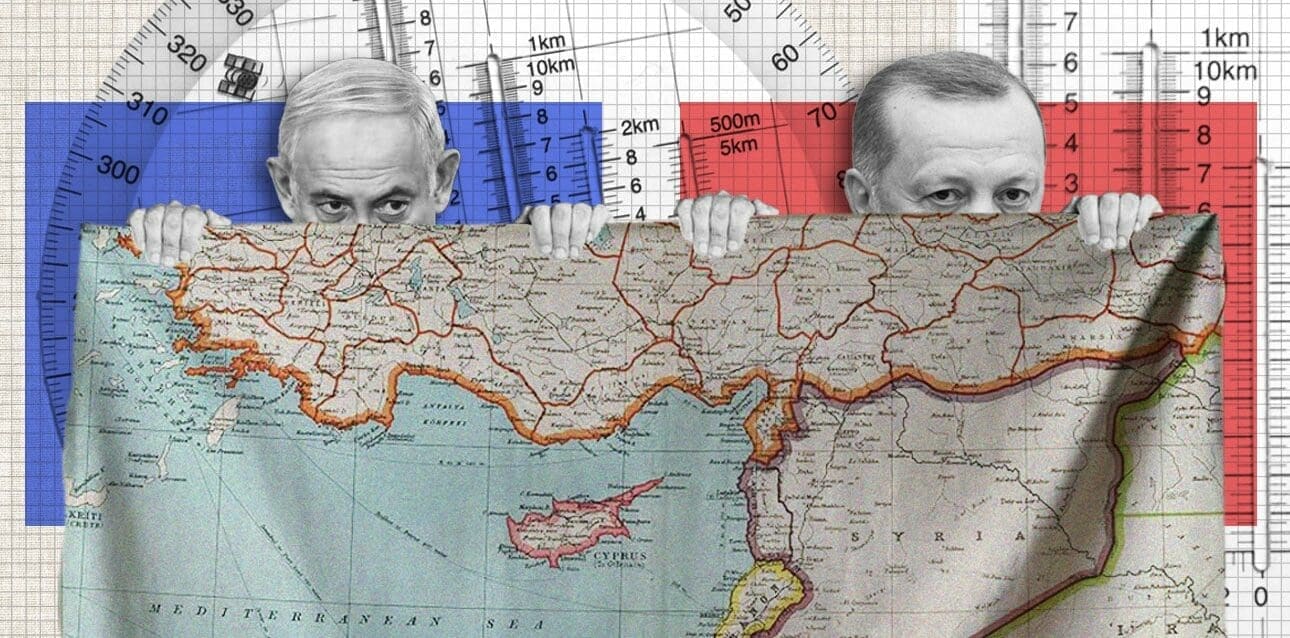
By George Lakasas
Acknowledgments
I would like to express my sincere gratitude to Stavros Kalenteridis, my bachelor’s thesis advisor, for his guidance, expertise, insights throughout my research, and encouragement to choose this specific topic. I want to thank my Professor, Dr. Iakovos Arapoglou, for his constructive feedback. Also, I want to express my deep appreciation towards my Professor, Alexandros Argyropoulos, and academic advisor Vicky Ampatzoglou for their assistance, even though they may not have realized the impact of their contributions. Finally, I would like to thank my family for their support throughout my academic journey.
1. Abstract
This thesis examines the evolving relations between Israel and Turkey, with a primary focus on the Syrian theater in the aftermath of the overthrowing of Bashar al-Assad in 2024. Situated within the broader context of Middle Eastern regional dynamics, the study explores how the post-Assad political and territorial fragmentation in Syria affect the geostrategic interests of both countries. The central question addresses under what conditions the Israeli strategy may constitute an obstacle to the advancement of Turkey’s regional objectives.
Employing qualitative research methods, the thesis draws on academic literature, policy analyses, and official statements in order to assess their interaction. The analysis is guided by a hybrid constructivist-realist framework, which tries to combine material considerations of security, threat perceptions and strategic narratives. The study advances the hypothesis that higher levels of fragmentation within Syria correspond to a reduced capacity for Turkey to consolidate political and strategic influence, a development that benefits Israel’s objectives.
The findings suggest that persistent fragmentation limits Turkey’s abilities, while simultaneously aligning with Israel’s preference for a weakened and decentralized Syria state. By focusing on the security concerns of both states, this thesis contributes to ongoing debates on the regional security architecture of the Middle East, post-conflict state fragmentation and the impact of external strategies in shaping policy dynamics.
Table of contents
- Abstract
- List of abbreviations
- Introduction
- Literature review
4.1 Realist approach
4.2 Hybrid constructivist-realist approach
4.3 Gaps in the literature
- Hypothesis
- Analysis
6.1 Neo-Ottomanism and Syria
6.2 Factors underpinning Turkey’s decision to assist the Syrian opposition to overthrow Assad in 2024 18
6.2.1 Assad’s potential re-alignment with the Arab World
6.2.2. Domestic developments
6.2.3 The Kurdish issue
6.2.4 Geo-economic considerations
6.3 Israeli interests in post-2024 Syria
6.3.1 Containing an unknown threat
6.3.2 Creation of a buffer zone
6.3.3 Patronage over the Druze community
6.3.4 Alignment with the Kurds
6.3.5 Domestic factors
6.4 Fragmentation as a tool to counter Turkey’s objectives in Syria
6.4.1 Brief history of political systems in post-Ottoman Syria
6.4.2 Fragmentation as federalism
6.4.3 Position of regional and world powers on the matter
2. List of abbreviations
| AKP | Turkey’s Justice and Development Party |
| DAANES | Democratic Autonomous Administration of North and East Syria |
| HTS | Hay’at Tahrir al-Sham |
| IMEC | India-Middle East-Europe Economic Corridor |
| SDF | Syrian Democratic Forces |
| SIG | Syrian Interim Government |
| SSG | Syrian Salvation Government |
3. Introduction
In December of 2024 after speedy military advances conducted by opposition forces, primarily the Syrian Salvation Government (Hay’at Tahrir al-Sham) with the support of Turkey, the regime of Bashar al-Assad collapsed, closing the main theater of operations of the Syrian Civil War. Following the capture of Damascus by the pro-Turkish HTS, the Turkish client-state of the Syrian Interim Government waged attacks across territories controlled by the Kurdish-Arab Democratic Autonomous Administration of North and East Syria (DAANES). The primary objective of the military operations was to extend Turkish control inside Syria against the Kurdish forces, in order to suppress their demands for autonomy. Almost simultaneously, in the midst of the administrative vacuum, the State of Israel crossed from the occupied Golan Heights into the peacekeeping United Nations Disengagement Observer Force’s zone, seizing effectively parts of it, as well as beyond it. Concurrently, Israel launched major airstrike operations deep inside Syrian territory, targeting military infrastructure, the army’s storage units, and sites of proposed Turkish deployment of military personnel. The airstrikes successfully incapacitated Syria’s capacities to defend and protect its airspace.
The events unfolding in Syria are undoubtedly of significant concern, with implications that will primarily affect the country itself, followed by broader repercussions for the wider Middle East, and ultimately the entire world on a macrohistorical scale. The vacuum of power in Syria distorts the status quo and creates a situation in which the security structure of the Middle East is undergoing a deep transformation. This event did not transpire without prior indication, and is part of a chain of actions that started with the catalyst Hamas’ invasion of Israel in October of 2023, which resulted in a) the freezing of the normalization process of ties between Israel and the Arab world, b) the freezing of the IMEC project, c) the crisis in the Red Sea, d) the Israeli invasion of Lebanon, primarily Hezbollah locations, e) the direct military engagement between Israel and Iran, and f) the war in Gaza.1
During this restructuring of the Middle Eastern security architecture, Turkey and Israel are among the main actors that want to utilize the opportunity to shape a new status quo that would suit their own geostrategic agenda. The two mentioned regional powers have clashed indirectly in Syria, as it is mentioned above, with Israel taking practical steps to block Turkey from being part of Syria’s future state building processes. As of recently, Assadist Syria was in the sphere of influence of both the Islamic Republic of Iran and the Russian Federation. Syria was of maximum importance for Iran, as it served as a corridor linking it, through Iraq, to their proxy in Lebanon, Hezbollah. Nevertheless, the reality is that Turkey’s position is becoming more and more ambiguous. When the Syrian opposition initiated the offensive to reach Damascus, and in its immediate aftermath, Turkey was seen as the main actor in the domestic affairs of the new Syrian state. But, as time passed it became more evident that Turkey was slowly losing its grip on the Syrian President, Ahmed al-Sharaa.
Among the various questions that emerge from the topic, this paper concentrates on the conditions under which Israel’s strategy may constitute an obstacle to Turkey’s pursuit of its own interests in post-Assadist Syria. This is a critical question, as it tries to interpret the dynamics of two prominent Middle Eastern powers, both of which are key allies of the U.S. in the region.2 At the same time, it seeks to contribute to the expansion of the academic discourse surrounding the subject-matter and foster a fruitful dialogue for future further analyses.
4. Literature review
To reiterate, the research question and focal point of this paper is as follows: under what conditions can the Israeli strategy in post-Assadist Syria be considered an obstacle to the advancement of Turkey’s interests in the region? With this in mind it is important to the research to underline the fact that the conflict between these two regional powers has been a matter of debate and continuous scholarly dialogue in the past decades. With the war in Gaza and the collapse of the Assad regime, this conflict has only evolved.
4.1 Realist approach
Israel and Turkey have two distinct and conflicting visions for Syria after Bashar al-Assad. This is the main argument of analyst Soner Cagaptay, who identifies security and national interest as the primary points that could lead to direct military engagement.3 The analysts Amare Aweke, Mohammed Seid and Suadiq Sufiyan identify a primary source of Turkey’s concern regarding Israel’s policy in Syria, namely its stance on the removal of all foreign military forces from Syrian territory.4 According to their assessment, Israel actively seeks to maintain exclusive influence over external intervention inside Syria, thereby perceiving Turkey’s “anti-terrorism” operations in the north of the country as infringements upon its regional interventionist prerogatives. Furthermore, the analysts observe that within the framework of current Israeli policy, the cohesion of a reorganized Syrian state is envisioned only to the extent that it does not constitute a security threat to Israel. In contrast, Turkey actively advocates for the establishment of a Sunni-led centralized government in Damascus, one that would align with Ankara’s strategic interests. From the Israeli perspective, however, the re-emergence of a Syria as Turkey seeks is undesirable; rather a fragmented or decentralized political configuration is deemed more conducive to Israel’s security objectives. This is a position strongly upheld by the Arab Center for Research and Policy Studies, which underscores that Israel’s recent military actions in Syria constitute a deliberate and premediated strategy to reshape the post-Assad regional order to its advantage. Backed by unwavering political and strategic support from the U.S., Israel has sought to maximize its power though the control over southern Syria and the sustaining of indirect leverage over the Kurdish forces in the northeast part of Syria, which has a continued U.S. presence.5 This is part of Israel’s plan to prevent the emergence of a unified Syrian state capable of reclaiming control over its border.6 With the fragmentation of Syria as Israel’s highest priority, analyst Ahmet Arda Şensoy links the mentioned goal with Israel’s survival,7 while Professor Gabi Siboni and analyst Erez Winner see to agree with Şensoy, highlighting the situation in Syria as a security opportunity for Israel.8
Going back to the analysis by Amare Aweke, Mohammed Seid and Suadiq Sufiyan, the Israeli strategic calculus underpins Israel’s sustained aerial campaign targeting prospective sites of Turkish military infrastructure within Syria’s territory, aimed at curbing Turkey’s further entrenchment in the region.9 According to the analysts, by an examination of a conflict Onion model,10 the core stance of Israel in regard to Syria is the establishment and maintenance of military supremacy, especially on the sky.11 Researcher Salim Çevik agrees and makes the same points when it comes to the Israeli doctrine of military supremacy in Syria against Turkey, as well as the effort to block the new Syrian government from consolidating power, in fear of potential security cooperation with Ankara.12 Signs of what a strong centralized Syrian government cooperating with Turkey would look like were already shown in September of 2025, when it was reported that Syrian troops began training inside Turkey.13 The analyst adds that this consolidation becomes less realistic as Israel’s support for the Druze community’s call for autonomy increases, as well as the expansion of the military occupation zone in the Golan Heights. The blocking of Turkey’s military influence in Syria is highlighted by researcher Gallia Lindenstrauss, who is making the point that the Israeli preventive strikes on Turkish-aspired military sites and air supremacy constrains Turkey’s strategic maneuvering. Lindenstrauss also links the interventionist Israeli activity to the proposed India-Middle East-Europe Corridor, that Israel actively advocates for, and that Turkey opts to redirect in their favor.14
Professor Dr. Özlem Tür, focuses on the 12-Day War’s result of showing to the Middle East the capabilities of Israeli air operations and the willingness to directly attack its adversaries.15 Based on this assumption, Dr. Tür makes the same points and agrees with the aforementioned analysts regarding the strategic goals of Israel in Syria and why they contradict Turkey’s, with a bigger focus on the Druzes and their part in the decentralized Syria that Israel seeks to create. Researchers Sinem Adar, Muriel Asseburg, Hamidreza Azizi, Margarete Klein and Guido Steinberg make the same point, as they identify Israel’s support for minorities, such as the Druze directly through armed support and indirectly the Kurds, as an instrument to maximize their security against foreign threats, like Turkey, which does not want minorities to hold significant power, i.e. the Kurds according to the researchers,16 who mention that for Ankara it is a “now or never” opportunity to completely close the Kurdish issue.17
Concurrently, Dr. Tür makes the case that direct strikes on Turkish soil are improbable, due to the participation of Ankara in the American-led North Atlantic Treaty Organization. For researcher Mehmet Rakipoğlu, Israel prioritizes its national security over international law and norms, crossing various red lines, and this creates a security concern for Ankara, thus Turkey has taken initiatives to contain Israel through inter-state rapprochement with Arab states, support for the Palestinian cause, and the development of a strong domestic defense industry. Rakipoğlu, on the other hand, recognizes that Turkey is acting in certain ways in order to avoid absenting the U.S. or its European partners.18 According to the mentioned researcher, Israel is disrupting Syria’s post-Assad’s fall reconstruction, by gaining influence inside the country with the backing of the U.S. and ignoring calls by the Arab states and Turkey to stop its aerial bombardments.19 Professor Muhittin Ataman agrees with the upper analysis and identifies that Israel’s main goals in Syria in relation to Turkey as (a) destabilization of the country and (b) elimination of other regional powers’ influence.20
Dr. Michael Rubin also identifies the 12-Day War as a catalyst for Israel-Turkey relations along with Dr. Tür, and makes the claim that Turkey is actively pursuing the goal of becoming patron of the terrorist anti-Israeli groups, Hezbollah and Hamas,21 placing Ankara in a trajectory of conflict with Israel.22 Dr. Rubin creates parallels between Recep Tayyip Erdogan’s Turkey and Ali Khamenei’s Iran, in a sense of deterministic outcomes, i.e. direct conflict with Israel. According to the analyst, Turkey’s NATO membership does not necessarily constrain Israel’s strategic behavior. For analyst Kristof Kleemann, the fact itself that al-Sharaa has the type of relation with Turkey is enough for Israel to feel unsafe and threatened.23
Simultaneously, Dr. Said al-Haj notes that Turkey’s gains from the removal of the Assad regime are the chance for normalization of bilateral relations with Syria, coupled with the establishment of a government receptive to cooperation, that could create favorable conditions for the re-initiation of strong economic and trade relations. Such developments may also accelerate the emergence of Syria as a critical corridor for Turkish overland trade with the Arab World. Furthermore, the potential repatriation of a substantial portion of the Syrian refugee population residing in Turkey would carry significant socioeconomic effects in favor of Erdogan. In this context, Turkey could assume a pivotal role in Syria’s post-war reconstruction process, thereby strengthening its geopolitical leverage vis-à-vis Israel. Dr. Haj makes the claim that common interests between Türkiye and Israel have become nearly nonexistent,24 placing the security of both in the forefront as the reason of their animosity, echoing the positions articulated by the aforementioned analysts.
Lastly, researcher Kassim Bouhou adds to this notion that Syria is on the brink of “Somalization”, and gives heavy gravitas to the role of the anti-Turkish Kurdish-led Syrian Democratic Forces in the north, and the pro-Israeli Druze faction in the south, which indirectly serve Israel’s goals, one of which is to derail the “disarmament, demobilization and reintegration” (DDR) process initiated by the Ahmed al-Sharaa government.25 Furthermore, Israel’s presence in south Syria serves dual strategic purposes: first, to secure its northern border and protect it from any perceived threats, and secondly, to prevent Turkish growing influence, as mentioned. This leads to the confrontation of a security dilemma, as mentioned back in the analysis by Amare Aweke, Mohammed Seid and Suadiq Sufiyan, and balance of power politics.26 For analyst Tal Beeri, Turkey already accepts the specific region of Syria as an Israeli sphere of military presence that should not challenge.27 This security dilemma, although, is a constrained one, based on the analysis by the Soufan Center, that claims that Benjamin Netanyahu and Erdogan are trying to navigate their way to expand their influence in Syria without disrupting their relations with the Trump Administration.28 The analysis also claims that U.S. officials are actively working on de-escalating the conflict.
4.2 Hybrid constructivist-realist approach
Dr. Hay Eytan Cohen Yanarocak looks at the events through constructivist lenses and claims that the Turkish aspiration for being involved in Syria is a “Trojan Horse” for its Neo-Ottoman ideology.29 According to Dr. Yanarocak, Erdogan’s government seeks to establish both military and ideological hegemony over Syria and to leverage this dominance in pursuit of its broader ambitions in the Near East. These ambitions encompass, among other, the strengthening of bilateral economic ties, the operationalization of the “Blue Homeland” 30 maritime doctrine through the signing of a maritime delimitation treaty-deemed illegal under international law-and the construction of military installations within Syrian proper, intended to suppress secessionist Kurdish activities and deter prospective Israeli intervention, maximizing its security. The perpetuation of Neo-Ottomanism is conceptually sound when we take into account the proposition made by analyst Chuck Freilich, that only Turkey (excluding Israel) is in a position to deploy ground troops in Syria.31 Freilich, although, proposes that through cooperation in a common mechanism can a crisis or war between Israel and Turkey be avoided. Scholar Bahram P. Kalviri directly links neo-Ottomanism to Israel’s security concerns over Syria.32
Lastly, analyst J. Adrien claims that Israel’s policy in Syria represents a deliberate strategic effort to limit and counterbalance Turkish influence, reflecting a distinctly realist approach to the matter, in which the pursuit of power, security and the maintenance of regional equilibrium are paramount. With the blending of constructivist lenses, Israel’s active support of minority groups, such as the Kurdish-led SDF and the Druze community, efficaciously creates local proxies that can resist or undermine Turkish-backed actions, a point that analyst Ahmet Memiş also agrees with.33 The very presence of these local forces constrains Turkey’s capacity to project authority over the new Syria, while allowing for Israel to enter and influence the domestic scenery.
For this approach, constructivist insights are limited and secondary to security-driven behavior and realist interpretations.
4.3 Gaps in the literature
The available literature provides valuable insights into the security calculations of both Israel and Turkey in Syria, yet there are some gaps that constrain the advancement of knowledge for the particular setting. Firstly, the realist approach, although has generated useful insights regarding state behavior in the Syrian theater, it is bias driven. From the various articles that this paper extracts information from, they are a subject of national academic or policy environments, including Turkish or Israeli, which tend to privilege the security priorities of the respective state. Sometimes, it was noticeable that the analyst or researcher was adopting a rhetoric in favor of their country. Notably, the Arab sources tend to take a neutral stance. Consequently, even though the examined works employ realist and neorealist theory, their analyses are grounded on national security narratives and policy agendas, rather than impartial application of the mentioned theories. The result is a lack of analytical neutrality. This does not mean that a constructive dialogue is impossible, but it highlights the fact that the literature remains relatively narrow, partly due to the fact that many political and security related developments in Syria are recent and still unfolding, which makes the research not desirably mature.
Furthermore, the analyses do not expand on what a fragmented Syria would look like, leaving a significant conceptual gap of the idea. Such a Syrian state could be interpreted in various ways, such as an internationally recognized division of Syria among ethnic or religious lines, a federalized state with autonomous regions divided as mentioned, or a pre-2024 status quo. Each scenario carries distinct implications for Israel and Turkey. By not properly addressing these scenarios, the analysts bypass critical circumstances that could shape their bilateral relations.
Lastly, there is an absence of ideological considerations, especially in the case of Turkey. The neo-Ottoman ideology that dominates the bureaucratic offices of the Turkish government exerts considerable influence over the state’s policy agenda and decisionmaking and is a significant driver of policy formation and behavior. The lack of such analyses is somewhat disappointing, given the ideological rhetoric expressed by the Turkish government after the fall of Assad.
5. Hypothesis
Based on the gaps and patterns identified in the literature review section, this research situates its analysis within the hybrid constructivist-realist school of international relations, which most effectively can be used in order to answer the research question. This theoretical approach offers the most conceptually coherent lens through which to examine the Israel-Turkey relations in regard to the current status-quo in Syria.
Building on the gap identified in the literature review, namely the limited analysis connecting Turkey’s imperialist ideology (neo-Ottomanism) with its actions in Syria, this study adopts the hybrid constructivist-realist approach as a consolidative analytical lens. This hybrid approach enables a more comprehensive examination of how self-imagined factors, such as historical self-perceptions and identity narratives, interact with the Turkish strategic behavior.
This hybrid constructivist-realist approach differs significantly from the analyzation of the research question just from the viewpoint of one theory. Firstly, although the realist school can provide the reasons for Turkey’s actions in Syria, mainly when it comes to security and power maximization, it does not take into account the ideological and identity-driven actions and communication of Turkish officials. On the other hand, a purely constructivist approach focuses on the neo-Ottoman ideology, but it could minimize the geostrategic calculations. Simultaneously, thinkers within the sub-realm of international relations have increasingly recognized that complex, multidimensional issues cannot be properly explained by the usage of a singular theoretical paradigm. For this reason, the employment of theoretical pluralism is thought of as satisfactory. Analysts Rudra Sil and Peter J. Katzenstein are among many scholars who highlight this point.34 Thus, major foreign policy events can be understood thoroughly only through the combination of traditions.
Based upon the gap in the literature in regard to the fragmentation of Syria and the hybrid constructivist-realist approach, a hypothesis is formulated, one which will be guiding this research: The higher the fragmentation35 level of the Syrian state, the less the Turkish influence inside the country.
6. Analysis
6.1 Neo-Ottomanism and Syria
As it was mentioned in the hypothesis section of the paper, the ideology of neo-Ottomanism will be thoroughly examined, as it is a central ideological force that shapes policymaking and decisionmaking of Erdoğan’s government, which includes post-Assadist Syria. Although some scholars and analysts argue that the ideology functions primarily for rhetorical legitimation rather than a coherent doctrine,36 this study treats it as a guiding ideological framework that shapes policy choices, particularly in Syria.
With the election of the Justice and Development Party (AKP) in the 2002 general election under the leadership of Recep Tayyip Erdoğan, Turkey’s foreign policy started to undergo an ideological and geostrategic reorientation. This reorientation, referred to as neo-Ottomanism, began to replace the Kemalist approach to foreign policy,37 although early steps towards this shift were already made by the then Prime Minister Turgut Özal during the 1980s and ‘90s.38 At its core, neo-Ottomanism is a revisionist ideology that seeks to disbalance the current status quo in the Middle East and Eastern Mediterranean and gradually replace it with Turkey in a more favored position.39
As Prime Minister, Erdoğan appointed Ahmet Davutoğlu as Minister of Foreign Affairs in 2009, who expanded upon the ideology and was the catalyst for its implementation in the foreign affairs sphere. Davutoğlu focused on Turkey’s strategic depth, a concept which cannot be understood without taking into consideration Turkey’s Ottoman heritage.40 Essentially, Davutoğlu’s thesis was that Turkey, due to its historical, cultural and religious ties across former Ottoman territories, possessed a unique advantage, which he called “civilizational depth”,41 which begins in the Balkans, goes through the Middle East and ends in North Africa.
In the case of Syria, the country has many sites of Ottoman and Turkish significance, such as the Tomb of Suleyman Shah,42 numerous buildings in the cities of Aleppo, Damascus, Hama and elsewhere, and religious ones, mostly mosques, that were constructed during the Ottoman period43, 44.
In 2011, when the Syrian Civil War started, Turkey initially remained neutral and did not challenge the Assad regime. This stance was modified and through the lenses of neo-Ottomanism, Erdoğan justified Turkish military interventions and economic support to opposition groups, based on the role Turkey supposedly has as the protector of all Sunni Muslims.45 As a result, three land invasions of North Syria occurred, in 2016, 2018 and 2019, which reflected also the security concerns that Ankara had about the Kurdish secessionist activity in the mentioned region. Turkey framed the invasions as part of its effort to stabilize a region which means a lot to the Turkish nation in regard to their history and culture.46
At this point it is crucial to mention two key concepts within neo-Ottoman discourse: the (a) Blue Homeland doctrine and (b) the Misak-ı Millî / National Oath. The first concept essentially delineates an expanded maritime jurisdictional claim that could be described as a Turkish “maritime living space”, one that, although, lacks the international law basis.47 Due to its geographical position, Turkey is lacking unobstructed access to the Eastern Mediterranean Sea and has to pass through the exclusive economic zones of adversary states, in particular Greece and Cyprus. As a result, the Blue Homeland doctrine is often interpreted as an imperialistic strategy.48 Within this framework, Turkey can assert maritime delimitation with Syria, that would have been rather unattainable under Assad regime.49
The National Oath is a territorial or “land-based” imperial vision that designates specific regions that Turkey claims is entitled to annex.50 The National Oath predates contemporary neo-Ottomanism, as was expressed and voted by the General Assembly of the Ottoman Empire in 1920.51 Since then, it has been repeatedly invoked by multiple Turkish politicians, including President Erdoğan in nationalistic rhetoric, thus reanimating its symbolical and political relevance.52 Central to the doctrine is the notion that Turkey could pursue territorial adjustments, originally through the conducting of local referenda, in areas including Syria, Iraq and Greece.53 The National Oath, although predates the neo-Ottoman ideology as mentioned, is frequently referenced by Erdoğan in his nationalistic speeches. In practice, Erdoğan’s articulation of the National Oath has been most visible in the Turkish policies and military operations in northern Syria.
Turkey’s actions in Syria led to the establishment of the Syrian Salvation Government, which was situated southeast of its Hatay province, with its capital being the city of Idlib. It acted as Turkey’s client quasi-state, and it was run by HTS54 under the leadership of Ahmed al-Sharaa.55 The state was funded56 and was operational due to Turkey’s influx of economic and military assistance.57 Simultaneously, another client state was established on the occupied, by Turkey, Syrian land, called the “Syrian Interim Government”. The SIG was established as the Syrian National Council’s alternative to Assad’s regime, which was formed immediately after the triggering of the Syrian Civil War in 2011, and was created as a government-in-exile, operating from inside Turkey,58 having the financial support of the United States.59 With the invasion and occupation of Syrian lands near the Turkish borders in 2016, the SIG was permitted to relocate there60 as a way to legitimize the Turkish invasion and start the groundwork for a future client government that would encompass the entire Syrian state.
The Assad regime was overthrown in December of 2024, with the SSG capturing Damascus and proclaiming al-Sharaa as the President of Syria. A key actor behind the successful operation conducted by the SSG was Turkey, something that was admitted by the U.S. President Donald Trump himself.61
6.2 Factors underpinning Turkey’s decision to assist the Syrian opposition to overthrow Assad in 2024
Turkey’s decision, as argued in the previous section, to support the Syrian opposition’s offensive in December of 2024 to overthrow Bashar al-Assad cannot be understood in isolation from the broader geopolitical, security and economic dynamics that had been unfolding in Syria and the Middle East. This section examines the interplay of these factors.
6.2.1 Assad’s potential re-alignment with the Arab World
The Syrian opposition’s military offensive did not come out of the blue. According to the New York Times it was orchestrated by the HTS and was planned months before its outbreak.62 The Minister of Foreign Affairs of Turkey since 2023, Hakan Fidan, had mentioned just days after Assad was ousted that it was the Syrian President’s attitude to not engage “in political dialogue with the opposition” that led to the offensive.63 Given Turkey’s extensive influence over the Syrian opposition, Fidan’s statement can reasonably be interpreted as referring to Ankara’s own demands. This could hold some merit if it is taken into consideration the fact that in May of 2023, the Assad regime was re-approached by the Arab World and re-admitted to the Arab League during its summit.64 In the same venue, Assad spoke against the “danger of expansionist Ottoman thought”. Qatar, a strong ally of Turkey, was against the prospect of normalizing its relations with the Assad regime, while Iran and Russia, allies of Assad, welcomed the development.65 In ensuing months after the summit, Turkey tried to approach Assad’s Syria, but the result was unfruitful, mainly due to Assad’s unchanging position.66
As a result of Assad’s comment, Ankara was alarmed, and possibly, was the catalyst for the initiation of crafting offensive military plans to remove the Syrian regime, before Assad became more engaged with the Arab World and rallied support against Turkey.67 This complex plan would not have been able to be materialize if not for a plethora of reasons,68 which among them is the reported bribing of the Syrian Army’s military personnel to commit mutiny.69
6.2.2. Domestic developments
Around the time of Assad’s fall, Turkey was going through some crises. Firstly, the country was hosting the largest number of Syrian refugees in the world, with around 3.5 million.70 This contributed to a rise of racism and xenophobia against the Syrians by the Turkish society, and also the rise of anti-Erdoğan rhetoric and against his government.71 The social pressure boiled over in June of 2024, when anti-refugee riots and attacks spiraled out of control.72
Another determinative issue was the deteriorating condition of the Turkish economy. In the aftermath of Erdoğan’s AK party defeat in the 2024 local elections, a range of reports positioned that the principal motion behind the event derived from the profound disadvantageous economic conditions affecting the country. These conditions led to millions of citizens experiencing financial insecurity and economic hardships. 73 The persistent inflation and currency instability generated strong sociopolitical pressure to the government, and an escape from sustained criticism involved shifting public attention away from economic grievances.74
An issue that was of concern of the AKP was the electoral underperformances and losses in the 2024 local elections, and the rise of prominent opposition figures. These losses are directly linked to the economic situation.75
6.2.3 The Kurdish issue
Another factor that was and is always in the mind of Turkish policymakers is the Kurdish issue. The very existence of DAANES, which is co-led by Kurds, poses a security risk to Ankara. The consolidation of an autonomous Kurdish political entity along Turkey’s borders, is unacceptable to Ankara. With the planned collapse of Assad, who was in a pragmatic understanding with the Kurds, Turkey anticipated that the Kurds would be strengthened, if not for immediate intervention to control them. The solidifying of a Kurdish entity would have been a contradiction to Turkey’s foreign policy objectives in Syria. Thus, the support that was offered to the Syrian opposition was not only about the installment of a friendly regime in Damascus, but also a proactive move to prevent the rise of further Kurdish gains. This led to the 2024 “Operation Dawn of Freedom”, which saw the invasion of DAANES territories by the SNA and Turkey, and the capturing of the city of Manbij.76
In January of 2026, DAANES was again invaded by the Syrian government. Its forces were unable to stop the advance, which resulted in the capturing of a large part of its territory. Concurrently, some local Arab tribes which were part of DAANES, switched sides and joined the Syrian government. This event further favors Turkey’s aspirations to eventually see the closing of this major theater of Kurdish activity in its border.77
6.2.4 Geo-economic considerations
Lastly, the economic considerations from the fall of Assad were significant for Turkey’s decisionmaking.78 During his second official state visit as President of Syria, al-Sharaa visited Ankara and discussed with Erdoğan about the prospective expansion of their bilateral economic relations.79 Al-Sharaa highlighted the need for cooperation on the economic field with Turkey, in order to reconstruct the war-torn country, with a particular focus on infrastructure development.80 These discussions led to the signing of various agreements, with most importantly the creation of a bilateral “Joint Economic and Trade Committee”,81 with the support of Qatar, the opening of a natural gas pipeline from Azerbaijan, via Turkey, towards Syria82 and the restoration of the historical Hejaz railway line, which would connect Turkey to markets inaccessible by land during the Assad regime.83
The Hejaz railway carried additional symbolic significance, as, historically, it was extensively used by the Turkish population to go and perform their pilgrimage to their holy cities, Mecca and Medina, and was promoted as a symbol of regional unity under the Ottomans.84
Lastly, the discourse around the development of energy pipelines that would go through Syria and turn it into an energy hub, has gotten louder. One of those pipelines is the proposed Turkey-Qatar natural gas one, a project that would have implications for the regional energy market and, in particular, for Israel’s interests.85
6.3 Israeli interests in post-2024 Syria
6.3.1 Containing an unknown threat
As previously noted, Israel’s unilateral actions may have indirectly contributed to conditions that facilitated the opposition’s eventual success in 2024. Throughout Assad’s tenure, Israel perceived Syria as a significant threat to its strategic interests and national security.86 This perception was largely driven by Syria’s close level cooperation with Iran, a key regional actor opposed to Israel’s existence. Since at least 2016, Assadist Syria was acting as a highway for Iranian military and ideological personnel, weapons and aid to reach their ally in Lebanon, the Hezbollah group.87 Given its proximity to Israel, Hezbollah represents a direct security threat, a reality that has been clearly demonstrated in past and recent conflicts. In exchange for its support, Assad received security assurances from Tehran, which played a crucial role in preserving the stability of his regime.
In the wake of the accession of Ahmed al-Sharaa to the Syrian presidency, Israel saw the creation of a new government, that was unfamiliar with and had its beginnings mainly from the terrorist group HTS.88 The group has its direct origins from al-Qaeda and the al-Nusra Front, both extremist Islamist groups,89 that Israel found hostile and undesirable to influence Syria’s political landscape. Although HTS eventually split with al-Qaeda and is claimed to have renounced jihadist ideology, it continued to adhere to Salafism,90 and found another patron, with that being Turkey, in order to survive.91 Al-Sharaa, thus, had relations with both al-Qaeda and Turkey, two of Israel’s enemies, meaning that it would only be natural for Tel-Aviv to harbor distrust towards the new regime in Damascus. The further cooperation with Turkey only exacerbates existing uncertainty, as Israel sees the possibility of the formation of a bloc between Qatar, Turkey, the Muslim Brotherhood and Syria, rising against it. Notwithstanding the failure of such a condition to be realized, another possibility is Syria reaching the point of another civil war, which again would be undesirable.92
Israel’s collective psychological trauma, shaped by historical experiences of existential insecurity (for the Jews, the Holocaust, and for the state, the constant violent conflicts with Arab countries),93 informs a heightened threat perception towards these developments. This trauma-driven security outlook constrains Israel’s willingness to trust regional actors, including Turkey whose expanding role in Syria is contradictory to Tel Aviv’s goals. A Syria aligned with a hostile Turkey, would lead to further security concerns of potential encirclement. Netanyahu has been a vocal proponent of Israel’s victimization and utilizes it in a way to rationalize the state’s actions abroad.94
This uncertainty brought the involvement of the U.S. by mediating between the two countries and leading to the creation of an intelligence sharing mechanism.95
6.3.2 Creation of a buffer zone
Another point of contention is the Israeli occupation of the Golan Heights. Since the war of 1967, Israel has continuously been occupying the geostrategic small strip of land, an action which has been condemned by the United Nations General Assembly.96 Following Assad’s departure, Israel crossed the borders with the United Nations Disengagement Observer Force, which was present in order to deter any hostile activities between the two countries97 and launched a massive aerial campaign to neutralize Syria’s military capabilities. The Israeli Army occupied Mount Hermon, which is of military, strategic and even religious importance to Israel.98 From this position, Prime Minister Benjamin Netanyahu proclaimed that southern Syria must become a demilitarized buffer zone.99 This policy serves several objectives. First and foremost, it exerts direct pressure on Damascus, as it is only 600km away from Mount Hermon. Secondly, it facilitates support for the Druze fighters of the region. Lastly, it strategically applies pressure on the neighboring Hezbollah in south Lebanon, cutting off smuggling routes.100
Israel seems to be seeking direct control over at least the Quneitra Governorate, in which the Golan Heights de jure belongs to.101
| Figure 1 Map of the situation in southern Syria. Source: ETANA organization, https://etanasyria.org/study-israels-strategy-in-south-syria/ |
6.3.3 Patronage over the Druze community
In the upper map, the position of the Israeli military forces is showcased and the maximum extent of Israel’s influence inside Syrian sovereignty. It should be noted that the Israeli buffer zone in light blue encompasses the entirety of the Druze community of Syria in its south. The Suwayda province is home to hundreds of thousands of Druzes,102 and after HTS and the SIG launched their offensives in December of 2024, they rose up, capturing a significant portion of the province. In January of 2025 Israeli Druzes protested in favor of Israel intervening in Syria in order to protect them,103 thus giving the justification to the Israeli military to carry out attacks inside Syria. In August of the same year, the Druze organized themselves into the Supreme Legal Committee in Suwayda, under the leadership of Sheikh Hikmat al-Hijri,104 with the goal of protecting and administrating their community105 from the Syrian transitional government, mainly due to the events of the massacres against the Alawites and Christians,106 two other minority groups inside Syria,107 and the Druze massacre in April.108
This action does not necessarily mean secession. The Druze’s spiritual leader in Syria, Seikh Hikmat al-Hijri’s ambition of seeing an independent Druze state109 is not a desire of the Syrian Druze spiritual leadership council, while his counterpart in Israel, Seikh Muwaffaq Tarif actively promotes the idea of the Druze maintaining their place inside Syria.110 This is a crucial point of debate inside the Syrian Druze community. What is the course that they should set in the post-Assad world? Two main camps exist: a. autonomy and siding with Israel or b. autonomy and maintaining their place in Syria. It can be observed that the common denominator is the call for autonomy. It is tough to calculate the balance of power inside their community, but for now it appears that an equilibrium is reached and an understanding between the two sides.111 This fact does not change Israel’s strategic planning, as it is reported that it is funding, arming and training Druze militias112,113.
At this point it has to be stated that there are three high spiritual Druze leaders in Syria who hold the title “Sheikh al-Aql”, being translated into “Elder of Reason”, and are the guides of their people. The title is a relic of a historic agreement between three powerful Druze families of Suwayda, the al-Hijri family, the al-Hinnawi family and the al-Jabrou family. The first mentioned family is considered to be the most influential in recent decades. 114 Sheikh Hikmat al-Hijri represents the first camp. In his public statements, he emphasizes the importance of the Suwayda region gaining a level of autonomy, bordering the idea of independence from Syria. Al-Hijri is concurrently the Head of the Supreme Legal Committee in Suwayda, a political and legal body that governs the area115, but his stance is not supported entirely by the Druze spiritual leaders of the region.
Sheikh Hammoud al-Hinnawi, another Sheikh al-Aql, publicly denounced al-Hijri’s policy of approaching Israel, although common ground between the two is the need for greater autonomy to be established for the region. According to al-Hinnawi, the Suwayda Druze must maintain a level of neutrality in the conflict that the Syrian government has waged against the minorities and avoid accepting Israeli protection.116 Lastly, Sheikh Yousef al-Jabrou supported the possibility of forging closer ties with Israel on March of 2025, but just four months later backed down.117 Al-Jabrou has been in the past a strong supporter of the Assad regime, and a crucial actor in the spreading of Assad’s policies inside the Druze community.118 Due to clan politics, al-Hinnawi and al-Jabrou have aligned together to combat al-Hijri’s influence.119
On the other side of the border in the west, in Israel, the Sheikh al-Aql is Muwaffaq Tarif, who, as it has been mentioned, does not promote the idea of self-determination for the Syrian Druze. Contrary, although, to his statements about the Druze maintaining their place inside a united Syria, he has occasionally called for the U.S. and Israel to intervene in the region and protect the Druze.120 Tarif is trying to reach and sustain an equilibrium that sees Israel actively supporting the well-being of the Syrian Druze, but at the same time not promoting autonomy, as it is something irreversible that brings uncertainty to the people in the area. Thus, Tarif’s mindset is shaped by the idea that the Druze should stay a part of Syria and restart their relations based on trust as a way to survive, and that can only occur with Israel’s support but not their vassalization to Tel Aviv.121
On the north, in Lebanon, the Druze leaders of their local community discourage separatism. Their spiritual leader, Sheikh Sami Abil-Mona has called on Israel to stop its intervention in Suwayda and claims that the conflict between the al-Sharaa government and the Druze can be resolved only through the mediation of Arab countries and Turkey.122 Simultaneously, the most influential Lebanese Druze politician, Walid Jumblatt, also advocates for a ceasefire in the region that would ensure the national unity of Syria and for the Syrian Druze to distance themselves from Israel.123 Both the spiritual and the political leader have raised alarms about the possibility of the conflict in Suwayda to spill-over to Lebanon, with sectarian violence spreading to their Druze community as well. But, the general atmosphere inside the Lebanese Druze seems to be rather against Jumblatt and his reading of the situation, primarily due to his positive relation with al-Sharaa.124
Still, Netanyahu wants from the Druze to play a role that will allow Israel to intervene in the domestic situation of Syria and influence decision and policymaking. The division of Syria along ethnic lines and its exploitation seem to be desirable by Tel Aviv,125 since the majority of Syria is Sunni Arab.126 By the same token, this leads to the Kurdish issue.
6.3.4 Alignment with the Kurds
The Kurdish population of Syria is estimated to be around 10%, and is mainly concentrated in the northeast, in the “Rojava”127 region.128 As it was mentioned in previous sections, the Kurds under DAANES, have been faced with Turkish aggression in the past years. During the civil war, the Kurds had aligned themselves with the Assad regime, in order to gain their autonomy after the war had ended. A month before the pro-Turkish groups launched their offensive in November of 2024, Israel’s Foreign Minister Gideon Sa’ar remarked that the Kurdish-Israeli relations should be strengthened and characterized them as “natural allies” of his country.129
With the collapse of the Assad regime, the alliance of convenience with him collapsed as well. Syria was in the midst of an administrative vacuum, and the Kurds were being pushed to give up their arms and integrate in the new Syrian army, with an agreement being reached in March of 2025.130 Nevertheless, the Turkish interventionist rhetoric131 did not ease the stress of a potential invasion, thus the Kurds continued to operate unilaterally and independently, resulting in small-scale armed conflict with al-Sharaa’s government.132 The Kurds seek de jure recognition of their autonomy in the northeast of Syria,133 in the model of the Iraqi Kurdistan. In January of 2026, after a military confrontation which saw the Syrian government capturing key territories of DAANES, al-Sharaa issued a degree that recognized for the first time in Syria’s history a Kurdish national language and rights, as a way to ease the tensions between the two sides.134
Although it seems that an alignment of interests between Israel and the Kurdish force in Syria is realistic, official governmental actions have not been taken by the side of Tel Aviv. The fact that pro-Kurdish articles are being written and published on Israeli newspapers and websites and are more numerous than pre-2024 is true, this pro-Kurdish sentiment has not been translated to actual policy initiatives. This cooperation between the two seems to be a scenario that is being investigated deeply by the Turkish side, and is not based on factual evidence, rather on speculation.135 Israeli discourse and media commentary may function as a signaling mechanism to spread this notion that the state will ally itself with the Kurdish forces, as a type of psychological operation aimed at the top officials and the general public to create uncertainty inside Turkey’s bureaucracy. The theory about Israeli-Kurdish cooperation is closely linked to the David’s Corridor project.136 After the January 2026 offensives, the Kurds have called upon Israel to side with them in order to retain their autonomy, something that Tel Aviv is unwilling to do.137
Both the approachment to the Druze and the Kurds seem to echo the “alliance of the periphery” unofficial dogma of former Prime Minister and Israel’s founder David Ben-Gurion, which called for an alliance of Israel with non-Muslim Arab actors in the wider Middle East region in order to survive against the hostile environment. This policy included at times both mentioned ethnic groups.138
6.3.5 Domestic factors
The topic of “Greater Israel” was considered a fringe revisionist idea and would not have anything to add to any kind of discussion before the Gaza War. The concept is popular among the discourse of both extremist Zionists and anti-Zionists.139 The reason that is included in this paper is due to Benjamin Netanyahu’s implicit ideological cue during an interview in which he claimed that the expansion of Israel is his goal. The interview was given to a right-wing journalist140 and was received with wide condemnation by Arab and Muslim countries, 31 states in total.141
The question of why Netanyahu would go as far as to, unofficially, endorse such a geopolitical plan that includes Syria’s territory needs an answer, as the domestic developments in Israel directly affect its foreign policy.
Netanyahu has been in a coalition government with far-right religious political parties since the 2022 general election.142 This creates an atmosphere of constant threat to the stability of his government. In general, coalition governments are more likely to have a shorter average lifespan than one party governments.143 For Israel after the 2022 election, it seemed that Netanyahu opted for any type of coalition with any political party, as long as they would be in agreement that he would take steps to reform and weaken144 the judicial branch of the government145 in order to avoid being sentenced due to his trial on alleged corruption. After major protests against him, Netanyahu’s approval rating fell sharply, with a July 2023 poll showing that 59% of Israelis disapproved of his job.146 After Hamas’ invasion, the offensive against Hezbollah, the Houthi attacks, the war with Iran, various domestic scandals (such as the Qatargate147) and the invasion of Syria, Netanyahu’s approval rating has recovered to a certain extent,148 and he has been able to extend his presence as Prime Minister by invoking the national emergency that Israel is going through.149
Netanyahu has successfully delayed his trial and, thus, his sentencing in the past two years due to the upper reason.150
Furthermore, the military victories in Syria could function as a strategic diversion of the public attention away from the ongoing and far more important Gaza theater. By emphasizing operational successes on that front, Netanyahu and the Israeli government may be able to temporarily change the domestic narrative and reduce public scrutiny against them associated with the Gaza war. These victories can be presented as evidence of Netanyahu’s ability to project Israeli power and safeguard the national interests of the state abroad. It is possible that Netanyahu wanted to create a “rally around the flag” effect, as he has been widely thought to have done in both the Gaza151 and Iran152 wars.
6.4 Fragmentation as a tool to counter Turkey’s objectives in Syria
Under the Assads, Syria had been a centralized authoritarian state, under the rule of a minority, the Alawites. The current governing body of Syria is majority Sunni Muslim, which reflects the religious demographic of the country.153 In the academic discourse, when referring to Syria’s fragmentation process, the focus mainly falls on the Kurds, Druze and Alawites, with most prominently due to the events analyzed in previous chapters of this paper, the Druze. Crucial is to reaffirm the hypothesis of this paper “the higher the fragmentation level of the Syrian state, the less the Turkish influence inside the country”.
6.4.1 Brief history of political systems in post-Ottoman Syria
There is precedent to the notion of a federalized Syrian state. During the French colonial occupation, presented as a League of Nations Mandate, and in accordance with the widely criticized Sykes-Picot Agreement,154 in 1922 the Federation of the Autonomous States of Syria was established. It was composed of three states, namely Aleppo, Damascus and of the Alawites’155 and served a policy of “divide-and-conquer”.156 This policy resulted in the division of the country known today as Syria into five governments (including Lebanon and the Druze state), with different budgets and constitutions,157 all being dependent on France for their protection.158 Before the Federation, the country existed briefly as a Kingdom under the rule of Faisal I of the House of the Hashemites, and with support from the British forces in the area.159 After a rapid French invasion160 to implement the Sykes-Picot Agreement in 1920, the monarchy was overthrown, and the mandate was officialized during the League’s San Remo Conference of the same year.161 France also established an autonomous Druze state in Suwayda.162
The Syrian federal project was terminated in 1925 by the French government, due to the need for a centralized state in the region to combat the growing nationalist movement, which was fueled by anti-colonial sentiment.163 This consolidation of power led to the Great Syrian Revolt, which, interestingly enough, was initiated by the Suwayda Druze.164 Due to French military tactical errors, Syrian nationalists rose up as well, but the revolt was eventually crushed in 1927.165 In 1928, Syrian delegates moved on with their demand for a new constitution, that in the end was adopted and proclaimed the First Syrian Republic in 1930, with characteristics of centralization and modeled as a parliamentary republic.166 The ensuing elections were won by the nationalist coalition. After the signing of the Franco-Syrian Treaty of Independence in 1936, the Alawite and Druze regions were officially integrated to Syria.167
In 1945, after the Second World War, Syria formally became independent and joined the United Nations.168 As an independent country, Syria kept its 1930 Constitution and proclaimed the Second Republic. In 1948, the Syrian Army allied with the wider Arab coalition and engaged in battle against the newly established State of Israel, resulting in its defeat and the overthrowing of the regime in 1949 via a CIA-backed169 military coup d’état,170 which established a more Western-oriented authoritarian government. The regime collapsed in August of the same year after a section of the army rose up, due to the regime’s leader’s intention to move militarily against the Druze community.171 Elements across the political spectrum, most notably Syrian nationalists and pan-Arabists, supported the coup. Wanting to preserve the democratic facade, the new military government re-established the civil rule. The August regime collapsed the same year in December, after a faction inside the military ousted its leader, due to his policy of unification with the Hashemite Iraq.172
After the December 1949 coup, Colonel Adib ash-Shishakli took power, although he realized that he had to maintain some aspects of the republic’s institutions, like the Presidency and the Assembly, among others. This led to a period where the military shared the governing of Syria with its elected representatives, most importantly the President. The country fell into a period of prolonged instability, which eventually came to an end after a self-coup in 1951,173 due to the re-animation of the discussion regarding union with Iraq and the Saudi Arabia’s stance against such a political union. Shishaki established a one-party rule over the country.174
In 1954, Shishaki was overthrown by a grand coalition of political parties and organizations, led by former President Atassi and Druze leader Sultan al-Atrash, due to his hostile stance against the minority.175 At this point in its history, the military was the only capable force inside Syria to take and keep the grip over power.
Following the Suez Crisis, pan-Arabism was the dominant ideology in the Syrian bureaucracy, leading to a union of the country with Gamal Nasser’s Egypt in 1958, but the discontent over who would have more influence inside the United Arab Republic led to its disbanding in 1961.176 The Ba’athist Party eventually came into power after a coup in 1963, that led to the creation of the second one-party rule system in Syria’s history. The Ba’athists were a mixture of pan-Arabist nationalists and Syrian nationalists, that wanted to shape the country according to their own ideology and vision called “neo-Ba’athism”. The ideology was based off various socialist ideas and opted to integrate militarism in the Syrian society.177 The political system of Syria was transformed to a totalitarian one, and lasted until 2024.178 With the rise of Hafez al-Assad to power in 1970, Syria became a hereditary dictatorship.179 Assad was able to bring the minority Alawites to dominate the military’s leadership, thus the state’s, and perpetuated phenomena such as sectarianism and minority-based nepotism.180 His son, Bashar al-Assad, succeeded him in 2000, changing little from his father’s style of ruling.
6.4.2 Fragmentation as federalism
From the above it is quite clear that Syria lacks the basis of democratic institutions, and federalism as a political system is absent from the life of the citizenry for a century. The system itself that was imposed to them was not to the benefit of the Arabs, Druze, Kurds and Alawites, but to the benefit of a colonial power. Parallels can be drawn between the policy of Israel and France, as Tel-Aviv’s policy appears to favor a federal system in the country, which can be interpreted as a “divide-and-conquer” strategy.
A fragmented system was always floating above the Syrians since the start of the civil war in 2011. The only major force that took steps to its enforcement were a coalition of Kurds and Arabs who formed the autonomous DAANES, as it has been mentioned before in this paper. In the post-2024 climate, decentralization movements are under military attack, meaning DAANES, the Alawites and the Druze. In August of 2025, the spiritual leaders of the former two mentioned minorities jointly declared their intention to engage with the new government in Damascus on the grounds of the formation of a decentralized or federal political system for Syria.181
The ideological conflict escalated when it was announced that the regions controlled by the Druze and DAANES would not hold parliamentary elections, as the rest of the country would, with their seats remaining vacant. The reason given was the unsafe conditions in those areas.182 This decision indirectly supports Turkey’s stance against the decentralization voices. Also, the absence of representatives from these regions removes the possibility of direct criticism towards al-Shaara and his government, all while these regions are excluded from the lawmaking process. Paradoxically, this fact can play in Israel’s favor, as the lack of communication between the minorities and the government pushes them to seek alternative sources of first and foremost protection and secondly economic support.
After the military confrontation in the city of Aleppo in January of 2026 between the Syrian government and DAANES, Alawites and Druze expressed solidarity towards the Kurds, and some raised the prospect that a federal system is needed.183 The Alawites, nevertheless, have been marginalized by Damascus, and do not have significant political capital. This fact does not mean that the al-Sharaa regime does not seek to approach them, as they are living in the only area where Syria has access to the sea, more specifically the Latakia and Tartus governorates. This by itself is an incentive for the regime to move forward from its March 2025 massacres against the minority, and try to reapproach them, in hopes of stabilizing the mentioned area.184
Israel and Turkey, as it has been mentioned already, differ on the constitutional basis of the political system of Syria. Both countries seek to influence, for their own maximization of power and geostrategic goals, the country. Israel, via its support to the Druze community, hopes to have an indirect place on the table of decisionmaking in Syria, with the purpose of expanding its foreign policy agenda, neutralizing potential threats and blocking Iranian and Hezbollah impact in the region. A fragmented federal system serves exactly those purposes. According to political scientist Daniel J. Elazar, “[…] federalism has not proved to be a particularly good device for integrating diverse nationalities into a single political system unless it has been accompanied by other factors compelling integration.”,185 which for the “divide-and-conquer” policy of Israel is exactly what is needed.
Turkey, on the contrary, views a centralized Syrian leadership as the most efficient regime for its own agenda. A centralized state with a dominant ethnic majority tends to ignore its minorities and makes it harder for them to enter into positions in the public sector’s decisionmaking.186 Turkey’s ambitions seek a centralized Syria that can enter into the broader neo-Ottoman vision and further it.
6.4.3 Position of regional and world powers on the matter
As it has been analyzed already, Israel and Turkey have conflicting views on the political system that must be employed by the new Syrian state. The stance of other regional and world powers has to be also examined, due to the fact that al-Sharaa has been trying to find support and create alliances with as many powers as he can and due to the opposite fact, that a plethora of powers have interests in the development of Syria and its global affiliation in international relations.
The U.S. is undeniably one of the most crucial actors in the stabilization and peace building process in Syria. Trump has mentioned repeatedly his vision of a Syrian success story,187 and this led him to the decision of lifting the sanctions that were imposed to the country by previous U.S. administrations, encouraging the American private sector to invest188 taking the place of the United States Agency for International Development that was fueling funds for various stabilization programs, including in DAANES territories.189 Although the U.S. government is concerned over sectarian violence, it has been trying to bridge the differences between Damascus and DAANES and mediate.190 Interestingly enough, it appears that the U.S. is not prioritizing the Druze neither the Alawites in its foreign policy.191
Simultaneously, Trump seeks to mediate between Israel and Syria, as evident by the January 2026 trilateral joint statement among them on the subject of facilitating peace.192 The President also opts to generally sustain an equilibrium between Israel and Turkey,193 which includes Syria, in order to expand the national and his own business endeavors in both countries.
The U.S. government holds an unfavorable view on the prospect of fragmentation, a position which has been expressed also by the Special Envoy to Syria, Thomas Barrack. Notably, Barrack also serves as the U.S. Ambassador to Turkey.194 The dual role could function as a diplomatic conduit between Syria and Turkey, facilitating closer bilateral engagement under U.S. guidance, while simultaneously advancing certain Turkish interests in neighboring Syria through his involvement.
For Saudi Arabia, a middle/regional power, Assadist Syria was part of the Iranian network of alliances in the Middle East, thus a direct threat to its interests.195 According to Professor John Calabrese, in the post-2024 environment, Saudi foreign policy has three core objectives in Syria: a. contain a potential radical Jihadist movement that would pose a threat to the Kingdom itself, all-while ending the narcotic trade in the region that various Jihadist groups are part of, b. drive-out the last remnants of Iranian influence and re-orientate Saudi’s focus on Turkey’s interests in the country, eventually constraining them, and c. invest in the country to make economic profit. According to Calabrese, al-Sharaa has shown willingness to approach the Gulf countries.196 The major issue for the Saudis, according to scholar Hesham Alghannam, is the involvement of two adversaries, Israel and Turkey, in Syria and their opposing visions for the country,197 one of expansionism and the other of neo-Ottoman ideology.198 Still, for the Saudis, Syria has to become part of a larger Arab bloc of stable countries, that would allow the Kingdom’s influence to reach the Mediterranean Sea.199
On the matter of fragmentation, the Saudis have not publicly asserted their view. Saudis have traditionally preferred stable centralized governments in their neighborhood, and do not view regime change as favorable, due to their own domestic fears of a similar event occurring against their royal family and rule,200 which is expressed through their commitment to state sovereignty.201 Nevertheless, the Kingdom seems to be favoring an integrated, unified Syria.202
Qatar and the United Arab Emirates, both regional powers, are both investing in Syria, and both prefer a stable regime, oriented by a centralized government. Concurrently, Qatar has aligned itself with Turkey, thus its foreign policy engagements with Syria have a positive spill-over effect on their ally.203 The UAE, on the other hand, has criticized Israeli expansionism into Syria,204 but has demonstrated willingness to support regime change movements, as illustrated by its involvement in Sudan and Yemen. Still, the government has repeatedly called for a unified and stable Syria.205
Russia, a world power, and as of recently the patron of Assad, has seen its influence inside the post-2024 Syrian environment heavily decreased. Although the presence of Assad in Moscow and his potential extradition is a major point of discussions between the Syrian and the Russian government, al-Sharaa seems to not set it as a spearhead of his approach towards Russia. Al-Sharaa wants to diversify his sources of foreign support and legitimacy, thus maintains a neutral approach towards Moscow, and it is to his understanding that relying on a single power for his regime’s protection is not suitable. The issue of their military installations in Tartous and Latakia seem to be quietly resolved, with Russians staying, while in exchange the Syrian government can utilize Russia’s diplomatic outreach to Israel in order to mediate between them when it comes to points of conflict.206 In official statements, Moscow expresses its support for a united Syria207 and for its territorial integrity208 and seems to have an understanding when it comes to the role the Syrian government wants it to play.209 This fact does not remove Moscow’s own geostrategic plans, that see the coast of Syria, the main area where the Alawites live, being under its influence, providing security to the minority, and also safeguarding its own interests in the Mediterranean Sea.210
Other international actors, such as India, support the construction of a peaceful and unified Syria.211 This position is consistent with India’s strategic commitment to the IMEC, the effective operation of which depends on sustained regional stability, of which Syria constitutes a key component. Similarly, permanent members of the United Nations Security Council, such as France and China212 have reiterated their support for a stable Syria and condemned any attempts to fragment the state.213 The President of France, Emannuel Macron, more specifically had ensured that his country is “totally in line on Syria” with Trump’s approach.214 The U.K. has emphasized the necessity of political representation of all minorities for long-term stability.215 However, it has refrained from endorsing federalism or a fragmented political system, instead favoring an inclusive centralized political framework.216
Lastly, Iran has emerged as the actor most adversely affected by the collapse of the Assad regime, losing a vital member of the Axis of Resistance, as it has already been explained. At present, Iran appears constrained in both its ability and willingness to pose a direct challenge to the al-Sharaa regime, primarily as a result of prevailing domestic pressures. The country is in a position of altering its foreign policy agenda, with the goal of avoiding isolation from the Arab world.217 The regime in Damascus, although, rather seeks to portray itself as completely anti-Iranian to gain a favorable view from Washington D.C. and Tel Aviv.218
7. Research findings
Guided by a hybrid constructivist-realist approach to international relations theory, this study examined Turkish-Israeli relations in the context of post-Assadist Syria, with particular attention to the divergent strategic objectives pursued by the two actors, and how the Israeli strategy can be considered an obstacle to the advancement of the Turkish. From a realist perspective, the analysis highlights the centrality of security considerations, territorial influence and maximization and projection of power in both states’ engagement within Syria. Simultaneously, a constructivist lens points to the historically embedded threat perceptions and identity narratives, like neo-Ottomanism. By analyzing their respective approaches to political influence, security concerns and regional positioning, the paper sought to assess the likelihood of a fragmented Syrian state and to evaluate which actor would derive greater strategic benefit from such outcome. The findings indicate that both countries are deeply embedded within the Syrian political and security landscape, actively working to consolidate their own spheres of influence. Each actor appears to engage, both directly and indirectly, in shaping the decisionmaking process, policy orientations and geostrategic calculations of the al-Sharaa government. Nevertheless, the nature of their involvement differs substantially. While Ankara’s strategy is largely oriented towards preserving the territorial integrity and maintaining leverage over a unified Syrian political structure aligned with its politico-ideological interests, Tel Aviv’s approach appears more compatible or even conducive to territorial and political fragmentation of the state.
The analysis presented suggests that a fragmented Syria would constrain Turkey’s scope to project sustained influence across Syrian lands. Conversely, fragmentation would possibly enhance Israel’s strategic flexibility by limiting the emergence of a strong, centralized Syrian state, capable of coordinating perceived hostile actions.
7.1 Challenges and implications
A central challenge to this research stemmed from the fact that it was conducted concurrently with the very events under examination. The events actively influenced the study’s analytical parameters and interpretive conclusions, while also influencing the selection of focal issues and emerging patterns. The fluidity of the political and security environment required continuous reassessment of assumptions, thereby complicating efforts to produce fixed or at least definitive interpretations.
As indicated in Section 9, a significant portion of the sources and references utilized in this paper originate from a single national context, specifically Turkey. This concentration necessitated particular caution in the interpretation of events, especially with regard to accounting for potentially inserted national perspectives and contextual assumptions. Nevertheless, it would be incorrect to question the validity or scholarly merit of these contributions, many of which offer empirically grounded and analytically robust insights into the matter. Rather, the limitation lies in the comparatively limited availability of sustained scholarly engagement from other regional and international contexts. A broader incorporation of cross-regional scholarship would therefore enhance analytical balance and strengthen future research on the relations between the two countries. Equally, it is essential to acknowledge that a portion of the sources and references originating from Israel may reflect national perspectives, particularly security narratives, threat perceptions and regional geostrategic priorities. For example, the concept of “David’s Corridor” appears with relative frequency in Turkish sources, where it is seldom referenced in other regional or international contexts. Similarly, the potential cooperation between the Kurds and Israel was also a talking point in Israeli sources, but not in other international contexts.
Another issue that has become prevalent in contemporary scholarly and media analyses is the propagation of misinformation and propaganda. As in all conflicts, such phenomena are to be expected. The extended conflict has created a highly polarized information environment, in which both state and non-state actors produce narratives that reflect strategic objectives and efforts to influence domestic and international perceptions.
7.2 Future research
Building on the findings of the analysis, the future trajectory of the Turkish-Israeli relations when it comes to Syria are likely to remain characterized by strategic restraint rather than cooperation or direct confrontation. As long as the territorial integrity and political configuration of Syria remains contested, both actors are expected to continue pursuing parallel but conflicting objectives.
From a theoretical perspective, the findings underscore the continued relevance of hybrid analytical approaches in understanding future conflicts. The persistence of historically embedded identity narratives, alongside realist calculations of power and security, suggest that future scholarship would benefit from further integrating constructivist and realist insights when examining similar cases of regional adversaries.
Lastly, future research could expand on this study by incorporating comparative cases of external actor competition in fragmented or post-conflict states, such as Libya, Yemen and Sudan. As Syria’s political environment continues to evolve, further empirical investigation will be essential for assessing whether current patters of restraint, rivalry, and asymmetry endure, or whether they will give space to new forms of alignments or competition.
8. Conclusion
This study has examined Turkish-Israeli relations within the context of post-Assadist Syria, using a hybrid constructivist-realist framework to analyze the strategic objectives and competing interests of both actors. Through this lens, the research explored how the two mentioned countries, each with its distinct geopolitical priorities, have engaged in the complex Syrian landscape after 2024. The findings suggest that while both states are deeply involved in Syria’s security and political environment, their approaches diverge significantly.
Turkey’s strategy revolves around the preservation of Syria’s territorial integrity, a stance that aligns with Ankara’s broader aim of countering Kurdish autonomy aspirations and maintaining a unified Syrian state that falls under its sphere of influence. In contrast, Israel seems more flexible toward the fragmentation of Syria, as such scenario would limit the rise of a strong, centralized government capable of mobilizing against Tel Aviv’s interests, or coordinating with hostile actors in the region.
The analysis presented herein indicates that a fragmented Syria would likely serve Israel’s geostrategic ambitions, by reducing the potential of a unified adversary to consolidate power. On the opposite side, Turkey’s position remains bound to the idea of sustaining a centralized government, which would provide security and influence. This divergence of interests highlights the broader geostrategic competition in the region, where both countries are scrambling for influence.
The study also confronted several challenges, particularly the rapidly changing political and security environment in Syria. The fluidity of the conflict combined with the evolving roles of regional and international actors demand continual reassessment of assumptions and interpretations. From a theoretical standpoint, the continued relevance of hybrid approaches in understanding the behavior of states in complex, fragmented and post-conflict environments is underscored in this research.
Syria’s ongoing fragmentation and shifting balance of power between Turkey, Israel and other state actors suggests that the geopolitical contest within the country will remain a key feature of Middle Eastern politics in the foreseeable future. As the international community continues to focus on Syria’s future, the strategies employed by Ankara and Tel Aviv will play a pivotal role in shaping a new security architecture and status quo in the Middle East.
9. References
1 The events in Gaza are a topic of debate. The United Nations and many scholars and other organizations have recognized Israel’s activities as genocide something that Tel Aviv denies. Source:
Office of the High Commissioner. (2025, September 16). Legal analysis of the conduct of Israel in Gaza pursuant to the Convention on the Prevention and Punishment of the Crime of Genocide. United Nations Human Rights. Retrieved February 11, 2026, from https://www.ohchr.org/sites/default/files/documents/hrbodies/hrcouncil/sessions-regular/session60/advance-version/a-hrc-60-crp-3.pdf
2 It is assumed throughout the paper that the U.S. does not want Israel and Turkey to engage in direct conflict.
3 Siddique, F. (2025). Virtual Policy Forum Series. (p. 3). Washington D.C.: The Washington Institute for Near East Policy. Retrieved February 11, 2026, from https://www.washingtoninstitute.org/policy-analysis/between-israel-and-turkey-implications-new-syria-part-2
4 Aweke, A. K., Seid, M., & Sufiyan, S. (2025, April 29). Ethiopia Institute of Foreign Affairs. Retrieved February 11, 2026, from www.ifa.gov.et: https://www.ifa.gov.et/2025/04/29/turkey-and-israel-on-the-brink-of-war-over-syria-context-interests-and-scenarios
5 This is in line with Hans J. Morgenthau’s classical realist conception of foreign policy as the pursuit of national interest translated into terms of power.
6 Arab Center for Research & Policy Studies. (2025, March 11). Retrieved February 11, 2026, from www.dohainstitute.org: https://www.dohainstitute.org/en/Lists/ACRPS-PDFDocumentLibrary/israeli-policy-on-syria-after-fall-of-assad-regime.pdf
7 Şensoy, A. A. (2025, September 11). Turkiye Arastirmalari. Retrieved February 11, 2026, from turkiyearastirmalari.org: https://www.turkiyearastirmalari.org/2025/09/11/yayinlar/yorum/israel-turkiye-and-the-challenge-of-syrias-post-war-stability
8 Siboni, G., & Winner, E. (2025, August 3). The Jerusalem Institute for Strategy and Security. Retrieved February 11, 2026, from jiss.org: https://jiss.org.il/en/siboni-winner-the-syrian-crisis-as-an-opportunity/
9 These actions can be characterized as the epitome of Robert Jervis’ security dilemma, due to the fact that as Israel’s protection capabilities against Turkey rise, Turkey’s decrease.
10 According to analyst Andreas Muckenfuß, a conflict Onion model helps “[…] [to] get to know each other’s interests and needs, […] It is based upon the idea that the layers of a conflict are much like that of an onion: there are many dynamics to be considered, but only those on the surface are visible, until we start to peel off the layers to see what lies at the core.” Source:
Muckenfuß, A. (2024). Building peace with an onion: VR-Simulation: Transforming conflicts between refugees and hostcommunities. Crisis Simulation for Peace. Retrieved February 11, 2026, from https://crisp-berlin.org/fileadmin/user_upload/2023_Draft_VRS_Bridging_Communities_Concept_Note.pdf
11 The article aligns with the broader literature of two international relations theories, realism and neorealism, as it emphasized national security, territorial integrity and military dominance in shaping state behavior according to the theories of Kenneth Waltz and John J. Mearsheimer.
12 Çevik, S. (2025, October 2). Arab Center Washington DC. Retrieved February 11, 2026, from arabcenterdc.org: https://arabcenterdc.org/resource/beyond-gaza-the-strategic-fault-lines-in-turkey-israel-relations
13 Kemal, L., & Soylu, R. (2025, September 9). Middle East Eye. Retrieved February 11, 2026, from www.middleeasteye.net: https://www.middleeasteye.net/news/turkey-begins-training-syrian-forces-under-new-security-deal
14 Lindenstrauss, G. (2025, November 18). The Institute for National Security Studies. Retrieved February 11, 2026, from www.inss.org.il: https://www.inss.org.il/wp-content/uploads/2025/11/No.-2061.pdf
15 Tür, Ö. (2025, July 18). InstanPol. Retrieved February 11, 2026, from istanpol.org: https://istanpol.org/en/post-strategic-fault-lines-in-the-middle-east-turkiye-between-iran-israel-and-syria
16 Adar, S., Asseburg, M., Azizi, H., Klein, M., & Steinberg, G. (2025, March 18). German Institute for International and Security Affairs. doi:10.18449/2025C11
17 Adar, S., Asseburg, M., Azizi, H., Klein, M., & Steinberg, G. (2025, February 15). German Institute for International and Security Affairs. doi:10.18449/2025C09
18 Rakipoğlu, M. (August 2025). SETA Foundation. Retrieved February 11, 2026, from www.setav.org: https://www.setav.org/en/turkiye-rises-as-the-gatekeeper-against-israeli-expansion
19 Rakipoğlu, M. (October 2025). Foundation for Political, Economic and Social Research. Retrieved February 11, 2026, from www.setav.org: https://www.setav.org/en/syrias-strategy-for-stability-patience-pragmatism-balancing-partners?
20 Ataman, M. (2025, July 23). SETA Foundation. Retrieved February 11, 2026, from www.setav.org/en: https://www.setav.org/en/syrias-stability-unity-and-future-are-under-israeli-siege
21 Schanzer, J., Ciddi, S., Sacks, M., & Rubin, M. (2025). Hamas and Turkey: Partners in Terror. Foundation for Defense of Democracies. Retrieved February 11, 2026, from https://www.fdd.org/wp-content/uploads/2025/03/fdd-memo-hamas-and-turkey-partners-in-terror.pdf
22 Rubin, M. (2025, June 25). National Security Journal. Retrieved February 11, 2026, from nationalsecurityjournal.org: https://nationalsecurityjournal.org/israel-iran-war-dry-run-for-a-future-war-with-turkey
23 Kleemann, K. (2025, March 17). Friedrich Naumann Foundation. Retrieved February 11, 2026, from www.freiheit.org: https://www.freiheit.org/de/naher-osten-und-nordafrika/100-tage-nach-dem-sturz-des-assad-regimes
24 al-Haj, S. (2025, January 9). Al-Zaytouna Centre for Studies & Consultations. Retrieved February 11, 2026, from alzaytouna.net: https://eng.alzaytouna.net/2025/01/09/strategic-assessment-137-turkiye-and-israel-do-diverging-interests-signal-a-potential-confrontation-in-syria
25 Bouhou, K. (2025, November 13). Désarmement, démobilisation et réintégration (DDR) en Syrie : dernière marche sur la route de la normalisation ? (IRIS, Interviewer) Retrieved February 11, 2026, from https://www.iris-france.org/desarmement-demobilisation-et-reintegration-ddr-en-syrie-derniere-marche-sur-la-route-de-la-normalisation
26 Adrien, J. (2025). Une rivalité recomposée : Israël et la Turquie dans la Syrie post-Assad. Les Jeunes IHEDN. Retrieved February 11, 2026, from https://www.jeunes-ihedn.org/wp-content/uploads/2025/06/LJI_DECRYPTAGE_Rivalite-recomposee-Israel-Turquie-Syrie-Post-Assad_Adrien-J_062025.pdf
27 Beeri, T. (2025, November 13). Alma Research and Education Center. Retrieved February 11, 2026, from israel-alma.org: https://israel-alma.org/syria-the-threat-to-al-shara-the-dangerous-scenarios-for-the-day-after-and-the-israeli-challenge
28 The Soufan Center. (2025, October 23). Retrieved February 11, 2026, from thesoufancenter.org: https://thesoufancenter.org/intelbrief-2025-october-23
29 Yanarocak, H. E. (2025, January 14). The Jerusalem Institute for Strategy and Security. Retrieved February 11, 2026, from jiss.org.il: https://jiss.org.il/en/yanarocak-turkeys-vision-transforms-post-assad-syria
30 For further information regarding the doctrine, go to chapter 6.
31 Freilich, C. (2025, March 9). The Institute for National Security Studies. Retrieved February 11, 2026, from www.inss.org.il: https://www.inss.org.il/wp-content/uploads/2025/03/e09032025-1.pdf
32 Kalviri, B. P. (2025, December 3). Modern Diplomacy. Retrieved February 11, 2026, from moderndiplomacy.eu:: https://moderndiplomacy.eu/2025/12/03/the-neo-ottoman-doctrine-and-the-inevitable-confrontation-in-the-levant/
33 Memiş, A. (2025, April 10). Uluslararası Diplomatik İlişkiler, Akademik Araştırmalar ve Eğitim Derneği. Retrieved February 11, 2026, from udiad.org: https://udiad.org/suriye-uzerinde-kesisen-stratejiler-turkiye-ve-israil-arasinda-gerilim
34 Rudra Sil and Peter J. Katzenstein have expanded upon their idea in their book Beyond Paradigms: Analytic Eclecticism in the Study of World Politics, in which they talk extensively about the aforementioned hybrid approach). Source:
Sil, R., & Katzenstein, P. J. (2010). Beyond Paradigms: Analytic Eclecticism in the Study of World Politics. Red Globe Press.
35 Fragmentation is meant to capture the deconstruction of central governmental power, not necessarily the de jure dissolvement of the Syrian state, but rather the fragmentation of political power.
36 Piotrowska, N. (2012, July 6). European Consortium for Political Research. Retrieved February 11, 2026, from https://ecpr.eu/Events/Event/PaperDetails/231
37 The Kemalists placed heavy gravitas on the Western and European direction of Turkey, and the re-enforcement of the existing status quo.
38 Murinson, A. (2009). Turkey’s Entente with Israel and Azerbaijan. Routledge. p. 119
39 According to political scientist and philosopher Robert Gilpin, war is the main mechanism through which a status quo can be transformed, an opinion he expressed in his 1981 book War and Change in World Politics.
40 Mazis, I. (2013). Νταβούτογλου και Γεωπολιτική (In Greek). Hrodotos. p. 21
41 Davutoğlu, A. (2001). Strategic Depth: Turkey’s International Position. Küre Yayinlari.
42Cagaptay, S. (2012, April 8). The Washington Institute for Near East Policy. Retrieved December 6, 2025, from www.washingtoninstitute.org: https://www.washingtoninstitute.org/policy-analysis/piece-turkey-lies-middle-syrian-desert
43 Danforth, N. (2015, March 11). Foreign Affairs. Retrieved February 11, 2026, from www.foreignaffairs.com: https://www.foreignaffairs.com/articles/middle-east/2015-03-11/exhuming-turkeys-past
44 Alafandi, R., & Rahim, A. A. (2016). The Legacy of Aleppine Ottoman Houses. In C. A. Brebbia, & A. M. Boquera (Ed.), Islamic Heritage Architecture (pp. 110-122). Wessex Institute of Technology Press. doi:10.2495/HA-V1-N3-388-400/012
45 Cagaptay, S. (2017). The New Sultan: Erdogan and the Crisis of Modern Turkey. I.B. Tauris.
46 Hintz, L. (2018). Identity Politics Inside Out: National Identity Contestation and Foreign Policy in Turkey. Oxford University Press.
47 Diakopoulos, A. (2022, September 19). Jacques Delors Friends of Europe Foundation. Retrieved February 11, 2026, from www.friendsofeurope.org: https://www.friendsofeurope.org/insights/turkeys-blue-homeland-ambitions-why-europe-cant-afford-to-sit-on-the-fence-but-turkey-can/
48 Adar, S., & Toygür, I. (2020, December). German Institute for International and Security Affairs. Retrieved December 5, 2025, from www.swp-berlin.org: https://www.swp-berlin.org/publications/products/comments/2020C62_EasternMediterraneanCrisis.pdf
49 Diakopoulos, A., Liakouras, P., Ifantis, K., & Filis, C. (2023, June 19). Kathimerini. Retrieved February 11, 2026, from www.ekathimerini.com: https://www.ekathimerini.com/opinion/1213618/behind-turkeys-blue-homeland-doctrine/
50 Arif, C. (1920, January 28). Turkish Historical Society. Retrieved February 11, 2026, from ttk.gov.tr: https://ttk.gov.tr/misak-i-milli-beyannamesi/
51 See footnote “48”.
52 Newsbeast. (2024, October 19). Retrieved February 11, 2026, from www.newsbeast.gr: https://www.newsbeast.gr/world/arthro/11740880/proklisi-erntogan-milise-gia-tin-tourkia-tou-ethnikou-orkou-me-edafi-apo-voulgaria-ellada-irak-kai-syria
53 It includes the following cities: Alexandrople of Thrace, Mosul and Kirkuk of Northen Iraq, Aleppo and Raqqa of Northen Syria.
54 The group is designed as a terrorist one by international organizations such as the United Nations, European Union and by states such as Russia and Canada.
55 Al-Sharaa was going by his nom de guerre / war name Mohammad al-Julani until he took over Syria in December of 2024. Ever since the civil war ended and for public relations reasons, he goes exclusively by his birth name.
56 According to analyst Haitham El-Zobaidi, Qatar was the main financial provider of the group. Source:
El-Zobaidi, H. (2024, December 4). The Arab Weekly. Retrieved February 11, 2026, from thearabweekly.com: https://thearabweekly.com/qatars-syrian-endgame
57 Çevik, S. (2024, December 20). Arab Center Washington DC. Retrieved December 4, 2025, from arabcenterdc.org: https://arabcenterdc.org/resource/turkey-and-the-transition-to-a-post-assad-regime-in-syria/
58 Ministry of Foreign Affairs of Turkey. (2013, March 19). Retrieved February 11, 2026, from https://www.mfa.gov.tr/no_-74_-19-march-2013_-press-release-regarding-the-establishment-of-the-interim-government-by-the-syrian-national-coalition.en.mfa
59 U.S. Department of State. (2015, October 31). Retrieved February 11, 2026, from https://2009-2017.state.gov/r/pa/prs/ps/2015/10/249033.htm
60 Öztığ, L. İ., & Adisonmez, U. C. (2026, January 5). Ontic Space Outside: Theorizing the Turkish-controlled ‘Safe Zone’ in Syria. (L. Maguire, Ed.) Oxford Intersections: Borders. doi:https://doi.org/10.1093/9780198945222.003.0158
61 Peters, G., & Woolley, J. T. (2025, September 25). The American Presidency Project. Retrieved February 11, 2026, from www.presidency.ucsb.edu: https://www.presidency.ucsb.edu/documents/remarks-prior-meeting-with-president-recep-tayyip-erdogan-turkey-and-exchange-with-2
62 Abdulrahim, R. (2024, November 29). The New York Times. Retrieved February 11, 2026, from www.nytimes.com: https://www.nytimes.com/2024/11/29/world/middleeast/syria-war-aleppo-rebels-government.html
63 Wintour, P. (2024, December 2). The Guardian. Retrieved February 11, 2026, from www.theguardian.com: https://www.theguardian.com/world/2024/dec/02/syria-crisis-summit-turkey-iran-russia
64 Al Jazeera. (2023, May 19). Retrieved February 11, 2026, from www.aljazeera.com: https://www.aljazeera.com/news/2023/5/19/assad-gets-warm-welcome-as-syria-welcomed-back-into-arab-league
65 Al Jazeera. (2023, May 8). Retrieved February 11, 2026, from www.aljazeera.com: https://www.aljazeera.com/news/2023/5/8/how-has-the-world-reacted-to-syria-rejoining-the-arab-league
66 Ciddi, S., & Epley, S. (2024, August 29). Foundation for Defense of Democracies. Retrieved February 11, 2026, from www.fdd.org: https://www.fdd.org/analysis/2024/08/29/syrias-assad-rebuffs-erdogans-effort-to-normalize-ties/
67 In realist terms, Turkish leadership was re-assessing the balance of power of the Turkish-Arab relations. It is not possible to say whether Assad could manage to create a strong anti-Turkish block inside the Arab League.
68 Developments that influenced the success of the overthrowing of Assad were: (a) The ignition of the War in Gaza in 2023, which saw Iran, one of the main patrons of Assad, moving its focus and capita on the Gaza theater. (b) The Israeli invasion of the Hezbollah-controlled southern Lebanon in 2024 and the subsequent elimination of its command. Hezbollah, throughout the years acted as Assad’s minutemen, assisting him when needed to enforce his rule, which would guarantee the safe passage of Iranian weaponry and supply towards them in Lebanon. (c) The 2024 intensifying of Israeli bombing of Iranian sites of interest inside Syrian territory. (d) The inability of Russia to react decisively to defend Assad, due to its war with Ukraine. Sources:
Ziadeh, R. (2024, December 17). Arab Center Washington DC. Retrieved February 11, 2026, from arabcenterdc.org: https://arabcenterdc.org/resource/deciphering-the-quick-collapse-of-the-assad-regime/
Partrick, N. (2025, December 8). ‘This ain’t gonna work’: How Russia pulled the plug on Assad. (C. Echols, Interviewer) Retrieved February 11, 2026, from https://responsiblestatecraft.org/assad-regime-collapse/
69 According to an article published by the Middle East Monitor, it is mentioned that high ranking officials inside Assad’s army were paid to not put up a fight (Middle East Monitor, 2024). This fact raises some serious questions about the origins of these funds. Source:
Middle East Monitor. (2024, December 12). Retrieved February 11, 2026, from www.middleeastmonitor.com: https://www.middleeastmonitor.com/20241212-demoralised-and-abandoned-by-allies-why-assads-army-failed-to-fight-in-syria/
70 Knipp, K., & Topcu, E. (2024, March 7). Deutsche Welle. Retrieved February 11, 2026, from www.dw.com/en: https://www.dw.com/en/as-turkey-syria-thaw-ties-unrest-may-derail-reconciliation/a-69547246
71 Cevik, H. (2025, February 4). From Open Doors to Closed Minds: The Transformation of Perceptions Toward Syrian Refugees in Turkey. The Journal of Race, Ethnicity, and Politics, p. 4. doi:10.1017/rep.2024.35
72 Kuşçuoğlu, V. (2024, July 2). Bianet. Retrieved February 11, 2026, from bianet.org: https://bianet.org/haber/violent-protests-target-refugee-community-in-turkeys-kayseri-after-alleged-sexual-assault-on-minor-297002
73 Karataşli, Ş. S. (2024, April 18). Jacobin. Retrieved December 10, 2025, from jacobin.com: https://jacobin.com/2024/04/turkey-elections-erdogan-economy-chp
74 Öztürk, A. E. (2025). Contesting Hegemony: Opposition Strategies and Structural Constraints in AKP-Era Turkey. ELIAMEP. Retrieved February 11, 2026, from https://www.eliamep.gr/wp-content/uploads/2025/12/Policy-paper-192-Ozturk-.pdf
75 Esen, B., & Gumuscu, S. (2024, April). Journal of Democracy. Retrieved February 11, 2026, from https://www.journalofdemocracy.org/online-exclusive/how-turkeys-opposition-won-big/
76 SOHR. (2024, December 9). Retrieved February 11, 2026, from www.syriahr.com: https://www.syriahr.com/en/350959/
77 Tabler, A. J., Jeffrey, J., Margolin, D., Zelin, A. Y., Cagaptay, S., Palti, Z., & Orion, A. (2026, January 23). The Washington Institute for Near East Policy. Retrieved February 11, 2026, from www.washingtoninstitute.org: https://www.washingtoninstitute.org/policy-analysis/kurdish-collapse-northeast-syria-key-things-watch
78 Özkizilcik, Ö., & Kemal, L. (2025, September 24). Atlantic Council. Retrieved February 11, 2026, from www.atlanticcouncil.org: https://www.atlanticcouncil.org/blogs/menasource/is-a-new-era-of-turkey-syria-economic-engagement-on-the-horizon/
79 VOA. (2025, February 4). Retrieved February 11, 2026, from www.voanews.com: https://www.voanews.com/a/syria-s-sharaa-meets-with-turkey-s-erdogan/7963366.html
80 Sıo, M. (2025, February 4). Anadolu Agency. Retrieved February 11, 2026, from www.aa.com: https://www.aa.com.tr/en/turkiye/syrian-president-al-sharaa-voices-desire-to-transform-ties-with-turkiye-into-strategic-partnership/3471864#
81 Ergocun, G. (2025, August 5). Anadolu Agency. Retrieved February 11, 2026, from www.aa.com: https://www.aa.com.tr/en/economy/turkiye-syria-sign-trade-agreements/3651233#
82 Tunakan, B., & Utucu, S. B. (2025, August 2). euronews. Retrieved February 11, 2026, from www.euronews.com: https://www.euronews.com/2025/08/02/kilis-aleppo-natural-gas-pipeline-opened-gas-flow-from-turkey-to-syria-started
83 Daily Sabah. (2025, September). Retrieved February 11, 2026, from www.dailysabah.com: https://www.dailysabah.com/business/economy/turkiye-syria-jordan-to-revive-historic-hejaz-railway-line
84 Alpay, E. K. (2025, January 1). TRT World. Retrieved February 11, 2026, from www.trtworld.com: https://www.trtworld.com/article/18249376
85 Rettig, E. (2025). The Syrian Pipeline Game: How Turkey’s Plans Affect Israel’s Regional Ambitions. Begin-Sadat Center for Strategic Studies. Retrieved February 11, 2026, from https://besacenter.org/wp-content/uploads/2025/01/7-Rettig-The-Syrian-Pipeline-Game.pdf
86 According to the ETANA organization, Assad was a threat to Israel, but also someone that could be controlled, thanks to the patronship of Russia. Any dispute that Israel had with him could be raised indirectly through Moscow. Source:
Etana. (2025). Israel’s Strategy in South Syria. Retrieved February 11, 2026, from https://etanasyria.org/file/2025/08/Israels-Strategy-in-South-Syria_ETANA.pdf
87 Valensi, C., & Naftali, M. (2024). Assad and the Axis of Resistance: A Tense Partnership Put to the Test. Institute for National Security Studies. Retrieved February 11, 2026, from https://www.jstor.org/stable/resrep65203
88 Beitinjaneh, S. (2025). The New Syrian Government: Turning a Page or Rewriting the Script? New Lines Institute. Retrieved February 11, 2026, from https://newlinesinstitute.org/sustainable-futures/the-new-syrian-government-turning-a-page-or-rewriting-the-script/
89 Ajjoub, O. (2025). Hay’at Tahrir al-Sham: From Jihadism to Syrian Islamism. Italian Institute for International Political Studies. Retrieved February 11, 2026, from https://www.ispionline.it/en/publication/hayat-tahrir-al-sham-from-jihadism-to-syrian-islamism-203506
90 Drevon, J., & Haenni, P. (2021). How Global Jihad Relocalises and Where it Leads: The Case of HTS, the Former AQ Franchise in Syria. European University Institute. Retrieved February 11, 2026, from https://cadmus.eui.eu/server/api/core/bitstreams/2b985c00-6254-51ee-8de4-7743c1897608/content
91 Lister, C. (2021, September). Twenty Years After 9/11: The Fight for Supremacy in Northwest Syria and the Implications for Global Jihad. CTC Sentinel, 14(7), p. 48. Retrieved February 11, 2026, from https://ctc.westpoint.edu/wp-content/uploads/2021/09/CTC-SENTINEL-072021.pdf
92 Orion, A. (2024). Israel and the Fall of Assad: Rejoice, Repel, Reach Out, Reload. The Washington Institute of Near East Policy. Retrieved February 11, 2026, from https://www.washingtoninstitute.org/policy-analysis/israel-and-fall-assad-rejoice-repel-reach-out-reload
93 Gutman, L. M., & Landau, S. (2024). Collective Trauma and Resilience for the Jewish People in the Aftermath of 7th. In R. Freedman, & D. Hirsh (Eds.), Responses to 7 October: Law and Society (pp. 59-67). Routledge. Retrieved February 11, 2026, from https://discovery.ucl.ac.uk/id/eprint/10196813/1/Collective%20Trauma%20and%20Resilience%20.pdf
94 Kalstein, J., Lučkova, A., Ragonese, E., Sacco, M., & György, R. (2024). Weaponising Collective Trauma: The Case of Russia and Israel. Cambridge Journal of Political Affairs, 5(2). Retrieved February 11, 2026, from https://www.cambridgepoliticalaffairs.co.uk/wp-content/uploads/2025/02/7_Collective_Trauma_GYORGY_KALSTEIN_-LUCKOVA_RAGONESE_SACCO.pdf
95 Salhani, J. (2026, January 7). Al Jazeera. Retrieved February 11, 2026, from www.aljazeera.com: https://www.aljazeera.com/news/2026/1/7/everything-you-need-to-know-about-the-syria-israel-deal-in-paris
96 UNGA. (2023). Resolution A/RES/78/77. New York City: United Nations General Assembly. Retrieved February 11, 2026, from https://documents.un.org/doc/undoc/gen/n23/398/06/pdf/n2339806.pdf?OpenElement
97 Krever, M. (2024, December 8). CNN. Retrieved February 11, 2026, from cnn.com: https://edition.cnn.com/2024/12/08/middleeast/israel-syria-security-implications-golan-intl/index.html
98 Hegglin, O. (2025). The Strategic Importance of Mount Hermon. Human Security Centre. Retrieved February 11, 2026, from https://www.hscentre.org/middle-east-and-north-africa/strategic-importance-mount-hermon/
99 Magee, C. (2025, December 5). Al Jazeera. Retrieved February 11, 2026, from www.aljazeera.com: https://www.aljazeera.com/news/2025/12/2/israels-netanyahu-says-deal-with-syria-possible-but-demands-buffer-zone
100 Habbas, W. (2025). Israeli National Calculations in Post-Assad Syria. Politics & Society Institute. Retrieved February 11, 2026, from https://politicsociety.org/2025/07/15/israeli-national-calculations-in-post-assad-syria/?lang=en
101 SOHR. (2026, January 20). Retrieved February 11, 2026, from https://www.syriahr.com/en/376632/
102 Heron, T. M. (2025, July 17). BBC. Retrieved February 11, 2026, from www.bbc.com: https://www.bbc.com/news/articles/c70xyv4z74go
103 YNET. (2025, January 5). Retrieved February 11, 2026, from www.ynetnews.com: https://www.ynetnews.com/article/s1frvszelx
104 Erem News. (2025, July 26). Retrieved February 11, 2026, from www.eremnews.com: https://www.eremnews.com/news/arab-world/zduyjgu
105 al-Nofal, W. (2025, August 12). Suwayda between self-administration and division: Are civil initiatives too late? (M. Nelson, Trans.) Retrieved February 11, 2026, from syriadirect.org: https://syriadirect.org/suwayda-between-self-administration-and-division-are-civil-initiatives-too-late/
106 France24. (2025, March 10). Retrieved February 11, 2026, from https://web.archive.org/web/20250311114358/https://www.france24.com/en/live-news/20250310-fear-among-syrian-christians-after-deadly-attacks
107 Rudaw. (2025, March 13). Retrieved February 11, 2026, from www.rudaw.net: https://www.rudaw.net/english/middleeast/syria/130320256
108 Syrian Observatory for Human Rights. (2025, May 1). Retrieved February 11, 2026, from www.syriahr.com: https://www.syriahr.com/عقب-التوتر-الطائفي-في-ريف-دمشق-والسويد/759348/
109 The Syrian Observer. (2025, July 16). Retrieved February 11, 2026, from syrianobserver.com: https://syrianobserver.com/syrian-actors/from-spiritual-guide-to-political-actor-who-is-sheikh-hikmat-al-hijri.html
110 Magally, N. (2025, September 9). Asharq al-Awsat. Retrieved February 11, 2026, from www.aawsat.com: https://english.aawsat.com/arab-world/5184305-majority-sweida-druze-elders-oppose-secession-syria
111 Feng, E. (2025, July 31). NPR. Retrieved February 11, 2026, from www.npr.org: https://www.npr.org/2025/07/31/g-s1-80018/druze-golan-syria-sweida-israel#:~:text=The%20Druze%20are%20a%20majority%20community%20in,Betrayed%20*%20Targeted%20by%20Sunni%20Muslim%20factions
112 Giuffrida, L. G., & Attanasio, S. (2025, December 18). The New Arab. Retrieved February 11, 2026, from www.newarab.com: https://www.newarab.com/analysis/living-shadow-israels-expanding-golan-heights-border
113 Shih, G., Flanzraich, A., Chamseddine, A., & Zion, I. B. (2025, December 23). The Washington Post. Retrieved February 11, 2026, from www.washingtonpost.com: https://www.washingtonpost.com/world/2025/12/23/israel-covert-activities-syria-druze/
114 Jameel, R. (2025, October 9). Hikmat al-Hijri: Druze Cleric Struggles Against Syrian Government. Militant Leadership Monitor, 16(2). Retrieved February 11, 2026, from https://jamestown.org/hikmat-al-hijri-druze-cleric-struggles-against-syrian-government/
115 See footnote “92” above.
116 SyriacPress. (2025, March 14). Retrieved February 11, 2026, from https://syriacpress.com/blog/2025/03/14/druze-leadership-in-syria-rejects-reconciliation-with-damascus-and-israeli-protection-offers/
117 Hosny, S. (2025, July 18). BBC Monitoring. Retrieved February 11, 2026, from https://monitoring.bbc.co.uk/product/b0004934
118 Al Jazeera. (2025, March 23). Retrieved February 11, 2026, from https://web.archive.org/web/20250323092959/https://www.aljazeera.net/amp/encyclopedia/2025/3/21/يوسف-جربوع-زعيم-درزي-حاول-إخضاع
119 See footnote “100” above.
120 Enab Baladi. (2025, May 13). Retrieved February 11, 2026, from https://english.enabbaladi.net/archives/2025/05/muwaffaq-tarif-calls-for-a-unified-syria/
121 Poidevin, O. L., & Al-Khalidi, S. (2025, December 10). Al-Monitor. Retrieved February 11, 2026, from https://www.al-monitor.com/originals/2025/12/israeli-druze-leader-seeks-us-security-guarantees-syrian-minority
122 Türkiye Today. (2025, July 19). Retrieved February 11, 2026, from https://www.turkiyetoday.com/region/lebanese-druze-leaders-urge-turkiye-arab-nations-to-intervene-in-syrias-sweida-3204427?s=1
123 Seifeddine, W., & Shamala, R. A. (2025, July 19). Anadolu Agency. Retrieved February 11, 2026, from www.aa.com.tr: https://www.aa.com.tr/en/middle-east/lebanese-druze-leader-urges-ceasefire-investigation-committee-in-syria-s-suwayda/3635401
124 Rebeiz, M., & Zaki, S. A. (2025, August 6). The Conversation. Retrieved February 11, 2026, from https://theconversation.com/the-druze-are-a-tightly-knit-community-and-the-violence-in-syria-is-triggering-fears-in-lebanon-261931
125 As of 2026, five member-states of the United Nations (Guatemala, Honduras, Papua New Guinea, Nauru and the U.S.) and one limited-recognized state (Kosovo) officially recognize Jerusalem as the capital city of Israel. For the academic neutrality of the paper, Tel Aviv will be mentioned as the capital city of Israel.
126 Doha Institute. (2025, March 11). Retrieved February 11, 2026, from www.dohainstitute.org: https://www.dohainstitute.org/en/PoliticalStudies/Pages/israeli-policy-on-syria-after-fall-of-assad-regime.aspx
127 “Rojava” can be translated as “Western Kurdistan”. Source:
Izady, M. (1993). Kurds: A Concise Handbook. Taylor & Francis.
128 Balanche, F. (2018). Sectarianism in Syria’s Civil War. Washington D.C.: The Washington Institute for Near East Policy. Retrieved February 11, 2026, from https://web.archive.org/web/20190626145902/https://www.washingtoninstitute.org/uploads/Documents/pubs/SyriaAtlasCOMPLETE.pdf
129 MacDonald, A. (2024, November 11). Middle East Eye. Retrieved February 11, 2026, from www.middleeasteye.net: https://www.middleeasteye.net/news/israel-foreign-minister-calls-kurds-minorities
130 Gritten, D., & Sinjab, L. (2025, March 11). BBC. Retrieved February 11, 2026, from www.bbc.com: https://www.bbc.com/news/articles/cedlx0511w7o
131 Khan, S. (2025, December 19). Modern Diplomacy. Retrieved February 11, 2026, from moderndiplomacy.eu: https://moderndiplomacy.eu/2025/12/19/syria-kurdish-forces-race-to-salvage-integration-deal/
132 Sharawi, A. (2025). Stalled Syria-SDF Deal Risks Sparking Wider Conflict. Foundation for Defense of Democracies. Retrieved December 19, 2025, from https://www.fdd.org/analysis/2025/08/14/stalled-syria-sdf-deal-risks-sparking-wider-conflict/
133 Lappin, Y. (2025, September 15). Alma Research and Education Center. Retrieved February 11, 2026, from israel-alma.org: https://israel-alma.org/the-wests-abandonment-of-the-syrian-kurds-and-its-geopolitical-implications/
134 Al Arabiya. (2026, January 17). Retrieved February 11, 2026, from https://english.alarabiya.net/News/middle-east/2026/01/16/syria-s-alsharaa-signs-decree-protecting-kurds-declares-kurdish-a-national-language-
135 BBC Monitoring. (2025, February 4). Retrieved February 11, 2026, from monitoring.bbc.co.uk: https://monitoring.bbc.co.uk/product/b0003a7u
136 After the establishment of the security buffer zone in south Syria, some analysts pointed out that Israel could connect through the Golan Heights and the Suwayda province to the U.S. controlled Al-Tanf military base in the center east of Syria and then towards the DAANES controlled territories effectively creating a security corridor. Officially, David’s Corridor is not to the active pursuit of the Israeli government and has not been mentioned as such. Source:
Yaghi, M. (2025, April 4). The Cradle. Retrieved February 11, 2026, from thecradle.co: https://thecradle.co/articles/davids-corridor-israels-shadow-project-to-redraw-the-levant
137 Petronella, F. (2026, January 22). Italian Institute for International Political Studies. (L. Dall’Asta, Editor) Retrieved February 11, 2026, from www.ispionline.it/en: https://www.ispionline.it/en/publication/syria-al-sharaas-offensive-against-the-sdf-reshapes-the-balance-of-power-228063
138 Alpher, Y. (2015). Periphery: Israel’s Search for Middle East Allies. Rowman & Littlefield Publishers.
139 Maţoi, E. (2024). Greater Israel: an Ongoing Expansion Plan for the Middle East and North Africa. Middle East Political and Economic Institute. Retrieved February 11, 2026, from https://mepei.com/greater-israel-an-ongoing-expansion-plan-for-the-middle-east-and-north-africa/
140 Times of Israel. (2025, August 12). Retrieved February 11, 2026, from www.timesofisrael.com: https://www.timesofisrael.com/liveblog_entry/netanyahu-says-hes-on-a-historic-and-spiritual-mission-endorses-vision-of-greater-israel/
141 Ministry of Foreign Affairs of Qatar. (2025, August 15). Retrieved February 11, 2026, from mofa.gov.qa: https://mofa.gov.qa/en/latest-articles/statements/31-arab–islamic-countries–arab-league–oic–gcc-condemn-so-called–greater-israel-vision
142 Asseburg, M., & Lintl, P. (2025). Israel’s Radical Government: Dismantling the Separation of Powers, Takeover of the State Apparatus, and Accelerated Annexation. German Institute for International and Security Affairs. Retrieved February 11, 2026, from https://www.swp-berlin.org/publications/products/comments/2025C18_Israels_Radical_Government.pdf
143 Carozzi, F., Cipullo, D., & Repetto, L. (2020). Divided They Fall: Fragmented Parliaments and Government Stability. University of Uppsala. Retrieved February 11, 2026, from https://www.diva-portal.org/smash/get/diva2%3A1416952/FULLTEXT01.pdf
144 See footnote “108” above.
145 Sharon, J. (2023, January 4). Times of Israel. Retrieved February 11, 2026, from www.timesofisrael.com: https://www.timesofisrael.com/justice-minister-unveils-plan-to-shackle-the-high-court-overhaul-israels-judiciary/
146 Etinger, A. (2025, July 30). Israel Hayom. Retrieved February 11, 2026, from https://www.israelhayom.co.il/news/politics/article/14441709
147 According to documents obtained by the think-tank Middle East Media Research Institute, allegedly Qatar wanted to provide funds to various Likud party members, including Netanyahu himself for undisclosed reasons. Source:
Uriel-Beeri, T. (2025, April 14). The Jerusalem Post. Retrieved February 11, 2026, from www.jpost.com: https://www.jpost.com/israel-news/article-849512
148 Jewish News Syndicate. (2025, October 15). Retrieved February 11, 2026, from www.jns.org: https://www.jns.org/netanyahus-approval-ratings-at-all-time-high-poll/
149 Damen, A., & Pfeiffer, S. (2025, October 25). NPR. Retrieved February 11, 2026, from www.npr.org: https://www.npr.org/2025/10/25/nx-s1-5582444/prime-minister-netanyahu-stands-increasingly-alone-at-home-and-abroad
150 Helm, T. (2025, December 22). The National News. Retrieved February 11, 2026, from https://www.thenationalnews.com/news/mena/2025/12/22/bizarre-week-at-netanyahu-trial-deepens-divisions-in-israel/
151 Kingsley, P., Bergman, R., & Odenheimer, N. (2025, July 11). New York Times. Retrieved February 11, 2026, from www.nytimes.com: https://web.archive.org/web/20250712120039/https://www.nytimes.com/2025/07/11/magazine/benjamin-netanyahu-gaza-war.html
152 Krämer, T. (2025, 26 June). Deutsche Welle. Retrieved December 28, 2025, from www.dw.com: https://www.dw.com/en/israel-iran-war-a-political-lifeline-for-netanyahu/a-73051182
153 Rands, T. (2025, April 15). Next Century Foundation. Retrieved February 11, 2026, from www.nextcenturyfoundation.org: https://www.nextcenturyfoundation.org/the-makeup-of-the-new-syrian-government/
154 The Sykes-Picot Agreement, which was signed in 1916 during the First World War, was a secret treaty regarding the partition of the Ottoman-controlled area in the Fertile Crescent. It was an agreement between the United Kingdom and France, which at the time were cooperating with the Arab nationalists to oust the Ottomans from the area. At its core, the agreement was a betrayal of the promises and assurances given to the Arabs, and a gross example of colonial style partitions, as it did not take into account the ethnographic characteristics of the land. Source: Rogan, E. (2016). The Fall of the Ottomans: The Great War in the Middle East. Basic Books.
155 Archontology. (2025, May 8). Retrieved February 11, 2026, from www.archontology.org: https://www.archontology.org/nations/syria/01_polity.php
156 France utilized the Kurds also, by moving large portions of their population from Turkey to the northern parts of Syria, attempting demographic engineering. Source:
Tejel, J. (2009). Syria’s Kurds: History, Politics and Society. Routledge.
157 Antonius, G. (1934). Syria and the French Mandate. International Affairs, 13(4), p. 526. doi:https://doi.org/10.2307/2603401
158 Citizens for a Secure and Safe America. (2023). Retrieved February 11, 2026, from c4ssa.org: https://c4ssa.org/syrias-journey-toward-democracy/
159 Antonius, G. (1938). The Arab Awakening. Hamish Hamilton Limited. Retrieved February 11, 2026, from https://archive.org/details/in.ernet.dli.2015.463895/page/n443/mode/2up
160 Tauber, E. (1994). The Formation of Modern Iraq and Syria. Routledge.
161 UN. (2019, March 12). Retrieved February 11, 2026, from www.un.org: https://www.un.org/unispal/document/auto-insert-207297/
162 Mullenbach, M. (n.d.). University of Central Arkansas. Retrieved February 11, 2026, from uca.edu: https://uca.edu/politicalscience/home/research-projects/dadm-project/middle-eastnorth-africapersian-gulf-region/french-syria-1918-1946/
163 Beshara, A. (2011). The Origins of Syrian Nationhood. Routledge.
164 Miller, J. L. (1977, October). The Syrian Revolt of 1925. International Journal of Middle East Studies, 8(4), pp. 550-555. Retrieved February 11, 2026, from https://www.jstor.org/stable/162567
165 Khoury, P. S. (1981, November). Factionalism among Syrian Nationalists during the French Mandate. International Journal of Middle East Studies, 13(4). Retrieved February 11, 2026, from https://www.jstor.org/stable/162909
166 ConstitutionNet. (2021, April). Retrieved February 11, 2026, from https://constitutionnet.org/country/syria
167 Filiu, J.-P. (2025). Bibliothèques d’Orient. Retrieved February 11, 2026, from heritage.bnf.fr: https://heritage.bnf.fr/bibliothequesorient/en/missed-opportunity-1936-franco-syrian-treaty
168 Albert Shanker Institute. (2025, February 13). Retrieved February 11, 2026, from www.democracyweb.org: https://www.democracyweb.org/study-guide/multiparty-system/syria
169 Wilford, H. (2013). America’s Great Game: The CIA’s Secret Arabists and the Shaping of the Modern Middle East. Basic Books.
170 Moubayed, S. (2004). Steel & Silk: Men & Women who Shaped Syria. Cune Press.
171 Dostal, J. M. (2015). Syria and the Great Powers (1946-1958): How Western Power Politics Pushed the Country Toward the Soviet Union. Syria Studies, 7(4), p. 23. Retrieved February 11, 2026, from https://ojs.st-andrews.ac.uk/index.php/syria/issue/view/127/1
172 Mahmmod, N. W. (2023). France’s Position on Adeeb Shishakli’s Coup on the Nineteenth of December 1949 AD. Journal of Tikrit University for Humanities, 30(4). Retrieved February 11, 2026, from https://jtuh.org/index.php/jtuh/article/view/2446/2260
173 al-Ayed, A.-N. (2017). Can Syria Be Salvaged? In B. Kodmani, & N. Moussa (Eds.), Out of the Inferno? Rebuilding Security in Iraq, Libya, Syria, and Yemen (p. 76). Arab Reform Initiative. Retrieved February 11, 2026, from https://s3.eu-central-1.amazonaws.com/storage.arab-reform.net/ari/2017/08/16145152/Arab_Reform_Initiative_Report_en_OUT_OF_THE_INFERNO_Rebuilding_Security_in_Iraq_Libya_Syria_and_Yemen.pdf
174 Torrey, G. H. (1964). Syrian Politics and the Military, 1945-1958. Ohio State University Press.
175 Alexander, A. (2011, March 29). BBC. Retrieved February 11, 2026, from www.bbc.com: https://www.bbc.com/news/world-middle-east-12890797
176 Stephens, R. H. (1972). Nasser: A Political Biography. Simon and Schuster.
177 Ben-Tzur, A. (1968, July). The Neo-Ba’th Party of Syria. Journal of Contemporary History, 3(3). Retrieved February 11, 2026, from https://journals.sagepub.com/doi/abs/10.1177/002200946800300310
178 Kassam, K., & Becker, M. (2023, May 16). Syrians of today, Germans of tomorrow: the effect of initial placement on the political interest of Syrian refugees in Germany. Journal Frontiers in Political Science. p. 2. doi:10.3389/fpos.2023.1100446
179 Meininghaus, E. (2016). Creating Consent in Ba‘thist Syria: Women and Welfare in a Totalitarian State. Library of Modern Middle East Studies.
180 Korany, B., & Dessouki, A.H. (Eds.). (2010). The Foreign Policies of Arab States: The Challenge of Globalization. p.423-424. The American University in Cairo Press.
181 Aziz, K. (2025, August 9). Kurdistan24. Retrieved February 11, 2026, from www.kurdistan24.net: https://www.kurdistan24.net/en/story/856727/druze-and-alawite-leaders-endorse-decentralized-syria-sparking-fierce-rebuke-from-damascus
182 Shelton, J. (2025, August 23). Deutsche Welle. (S. D. Inayatullah, Editor) Retrieved February 11, 2026, from www.dw.com: https://www.dw.com/en/syria-delays-election-in-sweida-and-kurdish-areas/a-73742611
183 Qadi, A. (2026, January 10). Kurdistan24. Retrieved February 11, 2026, from https://www.kurdistan24.net/en/story/886252/alawite-and-druze-leaders-declare-full-support-for-kurds-call-for-federal-system-in-syria
184 Azhari, T. (2026, January 3). Reuters. Retrieved February 11, 2026, from www.reuters.com: https://www.reuters.com/world/middle-east/facing-alawite-backlash-syrias-new-leaders-take-controversial-steps-win-loyalty-2025-12-30/
185 Elazar, D. J. (2006). Center for the Study of Federalism. Retrieved February 11, 2026, from federalism.org: https://federalism.org/encyclopedia/no-topic/federalism/
186 Khishtovani, G., Berianidze, M., Bakradze, N., Tsulaia, G., & Komakhidze, M. (2022). Taking Stock of Ethnic Minority Participation in Public Service. Policy and Management Consulting Research Centre. United Nations Development. Retrieved February 11, 2026, from https://www.undp.org/sites/g/files/zskgke326/files/2022-10/undp_ge_dg_par_enthic%20minorities%20in%20public%20service-survey-2022-eng.pdf
187 Bruce, T. (2025, July 17). U.S. Department of State. Retrieved February 11, 2026, from www.state.gov: https://www.state.gov/briefings/department-press-briefing-july-17-2025
188 Office of Foreign Assets Control. (2025, December 23). U.S. Department of the Treasury. Retrieved February 11, 2026, from ofac.treasury.gov: https://ofac.treasury.gov/media/934736/download?inline
189 Stebbins, S. A., Baker, A. B., & Aldridge, T. (2025). Operation Inherent Resolve and Other U.S. Government Activities Related to Iraq & Syria. Washington D.C.: U.S. Department of Defense; State; & USAID. Retrieved February 11, 2026, from https://www.stateoig.gov/uploads/report/report_pdf_file/oir_q3_jun2025_508.pdf
190 Frantzman, S. J. (2025, December 14). The Jerusalem Post. Retrieved February 11, 2026, from www.jpost.com: https://www.jpost.com/international/article-881262
191 Blanchard, C. M. (2025). Syria: Transition and U.S. Policy. Congressional Research Service. Washington D.C.: Library of Congress. Retrieved February 11, 2026, from https://www.congress.gov/crs-product/RL33487
192 U.S. Department of State. (2026, January 6). Retrieved February 11, 2026, from www.state.gov: https://www.state.gov/releases/office-of-the-spokesperson/2026/01/joint-statement-on-the-trilateral-meeting-between-the-governments-of-the-united-states-of-america-the-state-of-israel-and-the-syrian-arab-republic
193 Gal, S. (2025, December 31). The Times of Israel. Retrieved February 11, 2026, from timesofisrael.com: https://blogs.timesofisrael.com/trump-promised-turkey-israel-will-ensure-washington-blocks-it/
194 The Arab Weekly. (2025, October 8). Retrieved February 11, 2026, from thearabweekly.com: https://thearabweekly.com/us-brokered-talks-yield-temporary-truce-between-syrian-government-kurdish-forces
195 Alsudairi, M., & Ghiselli, A. (2025, August 8). Narratives of Sino-Middle Eastern Futures: In the Eye of the Beholder. Elements in Middle East Politics, p. 37. doi:https://doi.org/10.1017/9781009297851
196 Calabrese, J. (2025, December 19). Arab Gulf States Institute. Retrieved February 11, 2026, from agsi.org: https://agsi.org/analysis/recasting-syria-after-assad-saudi-arabias-bid-to-shape-a-gulf-led-regional-order/
197 Alghannam, H. (2025). Syria Becomes a Front Line in Protecting Saudi Security. Carnegie Middle East Center. Retrieved February 11, 2026, from https://carnegie-production-assets.s3.amazonaws.com/static/files/Alghannam_Saudi%20Security.pdf
198 Salami, M. (2025, February 17). Orion Policy Institute. Retrieved February 11, 2026, from orionpolicy.org: https://orionpolicy.org/saudi-arabias-stance-on-the-new-syria/
199 Kempe, F. (2025, December 19). Atlantic Council. Retrieved February 11, 2026, from www.atlanticcouncil.org: https://www.atlanticcouncil.org/content-series/inflection-points/dispatch-from-riyadh-why-syria-is-central-to-the-middle-easts-future/
200 Jones, T. C. (2011, April). Saudi Arabia Moves to Maintain Regime Stability. CTC Sentinel, 4(4), p. 2. Retrieved February 11, 2026, from https://ctc.westpoint.edu/wp-content/uploads/2011/05/CTCSentinel-Vol4Iss45.pdf
201 Heibach, J., & Cerioli, L. (2024). Saudi Arabia’s ambivalent stance on the Russia-Ukraine war: Balancing regime stability and equal sovereignty. Contemporary Security Policy, 45(4), p. 2. doi:https://doi.org/10.1080/13523260.2024.2384006
202 Saudi Gazette. (2025, March 11). Retrieved February 11, 2026, from https://cdn.saudigazette.com.sa/article/650028
203 Guzansky, Y., & Valensi, C. (2025, August 21). Institute for National Security Studies. Retrieved February 11, 2026, from www.inss.org: https://www.inss.org.il/publication/qatar-syria/
204 UAE Ministry of Foreign Affairs. (2025, August 27). Retrieved February 11, 2026, from www.mofa.gov.ae: https://www.mofa.gov.ae/en/mediahub/news/2025/8/27/27-8-2025-uae-syrian
205 UAE Ministry of Foreign Affairs. (2025, July 17). Retrieved February 11, 2026, from www.mofa.gov.ae: https://www.mofa.gov.ae/en/mediahub/news/2025/7/17/17-7-2025-uae-syria
206 Ali, M. H., & Ahmed, N. (2025, December 8). Italian Institute for International Political Studies. Retrieved February 11, 2026, from www.ispionline.it: https://www.ispionline.it/en/publication/after-assad-russias-role-and-leverage-in-the-middle-east-224080
207 TASS. (2025, February 12). Retrieved February 11, 2026, from tass.com: https://tass.com/politics/1912209
208 TASS. (2025, February 28). Retrieved February 11, 2026, from tass.com: https://tass.com/politics/1912209
209 Smagin, N. (2025, September 4). Carnegie Russia Eurasia Center. Retrieved February 11, 2026, from carnegieendowment.org: https://carnegieendowment.org/russia-eurasia/politika/2025/08/russia-syria-new-approach?lang=en
210 Nashed, M. (2025, March 20). Al Jazeera. Retrieved February 11, 2026, from www.aljazeera.com: https://www.aljazeera.com/features/2025/3/20/dont-trust-anyone-are-syrias-alawis-losing-faith-in-the-new-government
211 Siyech, M. S. (2026, January 6). Observer Research Foundation. Retrieved February 11, 2026, from www.orfonline.org: https://www.orfonline.org/english/expert-speak/pragmatic-continuity-understanding-india-s-engagement-with-syria
212 Khaliq, R. u. (2025, July 17). Anadolu Agency. Retrieved February 11, 2026, from www.aa.com.tr/en: https://www.aa.com.tr/en/asia-pacific/china-urges-respect-for-syrian-sovereignty-amid-israeli-airstrikes/3633402#
213 Permanent Mission of France to the U.N. (2025, April 10). Retrieved February 11, 2026, from onu.delegfrance.org: https://onu.delegfrance.org/france-reiterates-its-commitment-to-an-inclusive-political-transition-in-syria
214 Caulcutt, C. (2026, January 20). Politico. Retrieved February 11, 2026, from www.politico.eu: https://www.politico.eu/article/emmanuel-macron-decoded-text-message-donald-trump/
215 UK Mission to the UN. (2025, November 19). Retrieved February 11, 2026, from www.gov.uk: https://www.gov.uk/government/speeches/we-welcome-syrian-efforts-to-build-constructive-relationships-with-its-neighbours-uk-statement-at-the-un-security-council
216 Foreign, Commonwealth & Development Office. (2024, December 14). Retrieved February 11, 2026, from www.gov.uk: https://www.gov.uk/government/news/joint-statement-on-syria-14-december-2024
217 Toprak, E. G. (2025, December 28). Center for Iranian Studies. Retrieved February 11, 2026, from www.iramcenter.org: https://www.iramcenter.org/en/post-assad-syria-and-a-fractured-axis-how-is-irans-regional-role-evolving_en-2689
218 Iran International. (2025, November 12). Retrieved February 11, 2026, from www.iranintl.com: https://www.iranintl.com/en/202511122042